How Windgrove's AEO Strategy Drives B2B SaaS Pipeline Through Complex Buyer Journeys
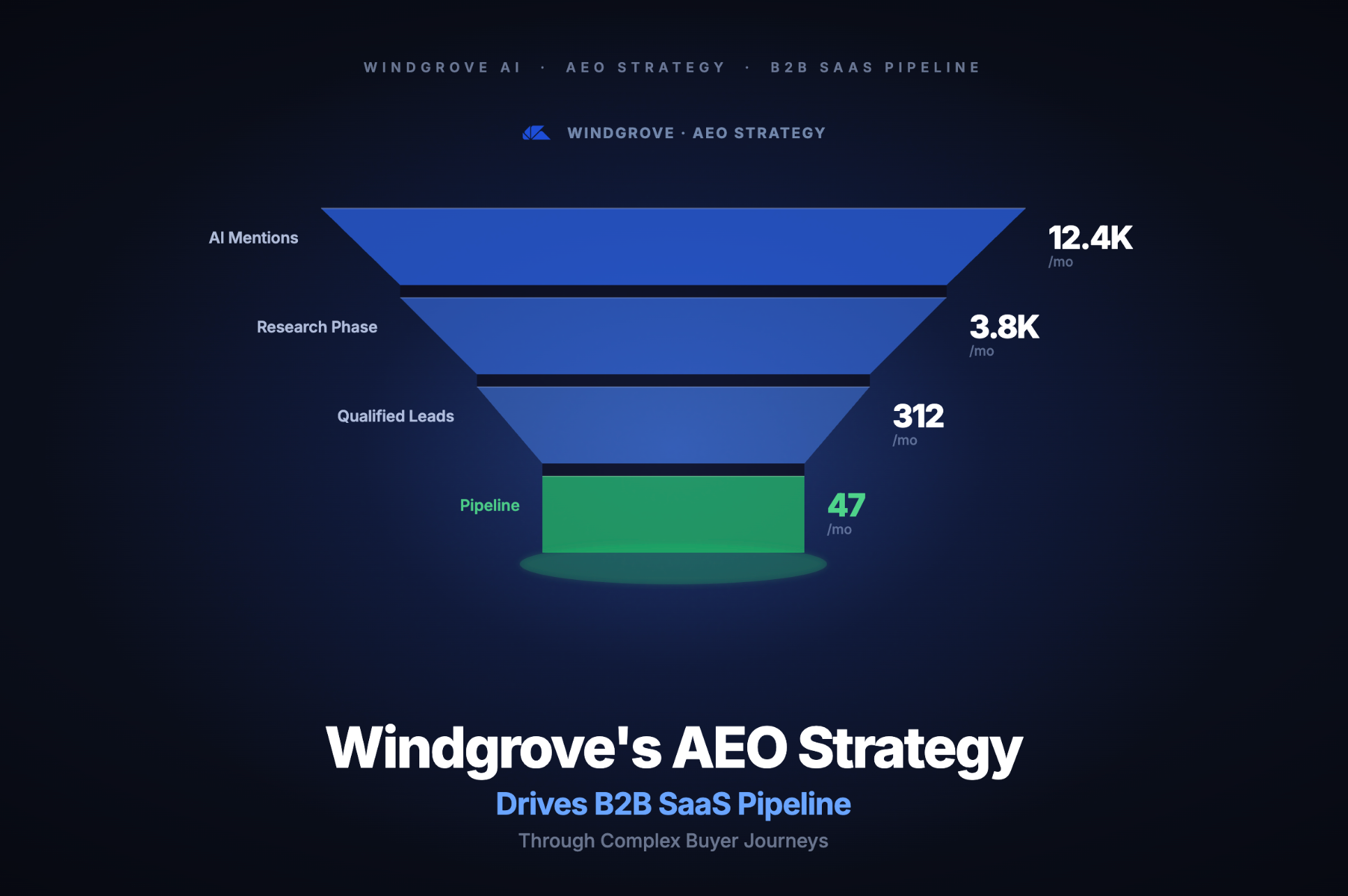
B2B SaaS buyers are no longer starting their research on Google. According to G2's 2025 buyer research, 87% of software buyers say answer engines changed how they research solutions, and 51% now default to AI chat for software shortlisting. When a VP of Operations asks ChatGPT "what's the best workflow automation tool for mid-market SaaS," your brand either shows up in that answer or it doesn't. There is no page two.
The problem is that most B2B SaaS companies are invisible in AI-generated answers, not because their product is weak, but because AI models lack the domain-specific context to recommend them. The content doesn't exist in the right format, the technical signals aren't there, and no one has told the AI what problem this company actually solves and for whom.
That's the gap Windgrove was built to close.
Executive Summary: Windgrove is an AI Visibility Agency that builds systematic AEO programs for B2B SaaS companies. The goal is simple: get your brand cited by ChatGPT, Perplexity, Claude, Gemini, and Grok when your ideal buyers ask the questions that matter most to your pipeline.
Four things that make Windgrove's approach different:
- Technical foundation first. AEO without the right infrastructure doesn't compound. Windgrove starts every engagement with a full technical audit before writing a single word of content.
- Data-driven content decisions. Every blog topic is chosen based on query intent data, ICP fit, and AI citation gap analysis, not gut feel or keyword volume alone.
- ICP-specific content. Windgrove helps clients get precise about who their best-fit buyer is, then writes content specifically for that buyer's questions, language, and decision criteria.
- Structured accountability. Weekly updates, biweekly reports, and monthly strategic calls keep every client's program on track and continuously improving.
Why AI Models Struggle with B2B SaaS
AI models are excellent at synthesizing general information. They are significantly weaker at understanding nuanced B2B domain expertise, complex sales processes, and the specific differentiation between SaaS vendors in crowded categories.
Ask ChatGPT to recommend a CRM for enterprise sales teams and it will name the same three or four brands it sees cited most often across the web. The brands that get cited aren't necessarily the best products. They're the brands whose content is structured in a way AI engines can parse, extract, and trust.
The uncomfortable truth: most B2B SaaS companies have years of product expertise and zero AI-readable content to show for it.
This creates a real pipeline problem. According to Forrester, 89% of B2B buyers have adopted generative AI as a primary source of self-guided research. If your brand isn't in those AI-generated answers, you're being cut from consideration before a single sales conversation happens.
The gap is widest in complex sales categories: vertical SaaS, multi-stakeholder deals, enterprise workflows, and niche B2B use cases where buyers ask highly specific questions that generic content can't answer. These are exactly the categories where Windgrove's approach has the most leverage.
Step One: The Technical AEO Foundation
Content strategy without a solid technical foundation is like running paid ads to a broken landing page. The traffic might show up. The conversions won't.
Windgrove starts every client engagement with a comprehensive technical AEO audit before any content is planned or published. This audit examines the signals AI engines use to evaluate whether a brand is credible, authoritative, and worth citing.
What the Technical Audit Covers
Signal Area | What Windgrove Evaluates |
|---|---|
Schema markup | Is structured data present and correctly implemented? Do AI engines understand what your company does and who it serves? |
Site architecture | Can AI crawlers navigate and index your content efficiently? |
Entity clarity | Does your brand have a clear, consistent identity across the web? |
Content structure | Are pages formatted with question-answer patterns, headers, and extractable data? |
Backlink authority | Do authoritative third-party sources reference and validate your brand? |
Most B2B SaaS sites fail on at least three of these five dimensions. A site can rank reasonably well on Google while remaining almost entirely invisible to AI answer engines, because the two systems evaluate content differently.
Google ranks pages. AI engines synthesize answers. The technical requirements are not the same.
Once the audit is complete, Windgrove builds the infrastructure that allows every subsequent piece of content to compound. Schema gets implemented correctly. Site architecture gets cleaned up. Entity signals get strengthened across the web. Only then does content work get started, because without the foundation, even the best-written blog post won't get cited.
Data-Driven Content: How Windgrove Decides What to Write
Publishing content without a targeting strategy is one of the most common and expensive mistakes in B2B marketing. Most companies write about what their team finds interesting, or what a competitor just published, or what a keyword tool says has high search volume. None of those inputs tell you what your buyers are actually asking AI models right now.
Windgrove approaches content selection differently.
Query Intent Research
Before any blog topic gets approved, Windgrove runs a query intent analysis. This means identifying the exact questions your ideal buyers are typing into ChatGPT, Perplexity, and Google, and mapping those queries to stages in your sales cycle.
A buyer at the awareness stage asks: "What causes [problem]?" A buyer at the consideration stage asks: "What's the best solution for [problem]?" A buyer at the decision stage asks: "How does [your product] compare to [competitor]?" Each of those queries requires a different type of content, and each one represents a different moment in the pipeline.
The goal is to have a credible, citable answer for every question your ICP is asking at every stage of their journey.
Why Topic Selection Is a Strategic Decision
Not all blog topics are equal from an AEO standpoint. Windgrove evaluates each potential topic against three criteria:
- AI citation gap: Is this a question where AI models currently give a weak or generic answer? If so, there's a real opportunity to become the cited source.
- ICP relevance: Does this query come from the type of buyer the client actually wants to close? High-volume topics that attract the wrong audience waste everyone's time.
- Pipeline stage alignment: Does this content move a buyer closer to a conversation, or does it just generate impressions?
Only topics that pass all three filters make it into the content calendar. This is what separates an AEO content program from a generic blog strategy.
Writing for Your ICP, Not the Algorithm
Most B2B content is written for a vague, imaginary reader. It tries to appeal to everyone and ends up resonating with no one. AI engines can detect this. Generic content gets deprioritized in favour of content that demonstrates specific, credible expertise for a specific audience.
Windgrove's content work begins with a critical upstream question: who is your best-fit customer, and what do they specifically need to believe to choose you?
Getting Clear on the ICP
Before writing a single piece of content, Windgrove works with clients to sharpen their Ideal Customer Profile. This isn't a demographic exercise. It's a strategic one. The questions that matter are:
- What is the specific problem this buyer is trying to solve, in their own words?
- What does their buying committee look like? Who is the economic buyer, and who is the technical evaluator?
- What objections do they raise before signing? What do they need to see to feel confident?
- What language do they use when they describe the problem? Not your language. Theirs.
That last point is where most B2B content fails. Companies write about their product using their internal vocabulary. Buyers search using their own vocabulary. The gap between those two languages is where AI visibility is lost.
ICP-Specific Content in Practice
Once the ICP is defined, every piece of content is written to speak directly to that buyer's reality. This means:
- Using the exact phrasing and terminology your buyer uses in their searches
- Addressing the specific objections and comparison questions that come up in your sales cycle
- Structuring answers in a way that maps to how that buyer evaluates vendors
The result is content that doesn't just rank or get cited. It arrives pre-loaded with the context a buyer needs to take the next step. According to the Previsible AI Traffic Report, visitors arriving from AI-generated answers convert at 4.4x the rate of standard organic search visitors, because the AI has already done the pre-qualification work.
That conversion advantage only materializes when the content was written for the right buyer in the first place.
Accountability Built Into the Program
AEO is not a set-it-and-forget-it channel. AI models update their training data, citation patterns shift, and what gets cited today may need to be refreshed in 90 days. The brands that sustain AI visibility are the ones that treat it as an ongoing program, not a one-time project.
Windgrove builds structured accountability into every client engagement through a three-tier communication cadence.
The Reporting Cadence
Weekly updates keep clients informed on what was published, what technical changes were implemented, and what early signals are showing up in AI citation tracking. No surprises. No black boxes.
Biweekly reports go deeper. These include AI visibility metrics across ChatGPT, Perplexity, Claude, Gemini, and Grok, query performance data, content that's gaining traction, and content that needs iteration. The report is designed to answer one question: is the program moving the needle?
Monthly strategic calls are where the bigger picture gets reviewed. Windgrove and the client align on ICP refinements, new query opportunities, competitive shifts in AI citations, and content priorities for the next 30 to 60 days. These calls are not status updates. They are strategic working sessions.
"Most B2B brands show up in fewer than 20% of relevant AI responses, even when they rank well in Google." — Optimist, 2026
That number moves. The reporting cadence is what ensures it moves in the right direction.
What Gets Measured
Metric | What It Tells You |
|---|---|
Share of Model Response | How often your brand appears in AI answers for your key buyer queries |
AI citation count | How many times your content is cited as a source across AI engines |
Query coverage | What percentage of your ICP's key questions you have content for |
Pipeline attribution | Which AI-sourced visits convert to demo requests or qualified leads |
The goal is not impressions. The goal is pipeline. Every metric in Windgrove's reporting framework traces back to that outcome.
The AI Search Interface Your Buyers Are Using
This is where your buyers are researching vendors right now. Perplexity alone captures nearly 20% of AI search traffic in the US and is growing 25% every four months. When a buyer asks a question here, the AI synthesizes an answer from sources it deems authoritative. Your content either makes that cut or it doesn't.
Only 11% of domains are cited by both ChatGPT and Perplexity, which means a multi-model AEO strategy isn't optional. Each engine has different citation preferences, and Windgrove's approach accounts for all of them.
The Window Is Still Open. Not for Long.
The AEO landscape in most B2B SaaS categories is still wide open. Your competitors have not built this infrastructure. Most are still running the same SEO playbook they used in 2022, optimizing for blue links while their buyers migrate to AI-generated answers.
That is a narrow window.
According to ZeroClick Labs' 2026 AI SEO report, only five brands capture roughly 80% of AI responses in any given category. The brands that move first, build the technical foundation, and publish the right content for the right ICP will hold those positions. The brands that wait will find themselves in the same position most companies found themselves in with SEO in 2015: playing catch-up in a game where the early movers already own the territory.
Windgrove exists to help B2B SaaS companies claim that territory before someone else does.
Ready to see where your brand stands in AI-generated answers? Book a discovery call with Windgrove and get a clear picture of your current AI visibility, your biggest gaps, and what it would take to close them.
Frequently Asked Questions
What is AEO and how is it different from SEO?
Answer Engine Optimization (AEO) is the practice of structuring your content and technical infrastructure so that AI engines like ChatGPT, Perplexity, Claude, Gemini, and Grok cite your brand when buyers ask relevant questions. SEO optimizes for ranking in a list of links. AEO optimizes for being selected as the trusted source inside a synthesized answer. The two disciplines overlap but require different strategies, and AEO is increasingly where B2B buyer decisions are being made before a vendor is ever contacted.
How long does it take to see results from AEO?
Most clients begin seeing measurable improvements in AI citation frequency within 60 to 90 days of the technical foundation work being completed. Content compounds over time, meaning the program becomes significantly more effective at the 6-month and 12-month marks as topical authority builds across more of the buyer's query landscape. AEO is a compounding channel, not a one-time campaign.
Do I need to abandon my existing SEO strategy to invest in AEO?
No. AEO is an extension of SEO, not a replacement. The technical foundations overlap significantly, and well-structured content that performs in AI-generated answers typically also performs well in traditional search. Windgrove's approach is built to strengthen both channels simultaneously, which is why the technical audit comes first.
How does Windgrove decide which blog topics to prioritize?
Every topic is evaluated against three filters: whether there is an AI citation gap (meaning AI models currently give a weak answer for this query), whether the query comes from your ICP, and whether the content will move a buyer closer to a pipeline conversation. Topics that don't pass all three filters don't make the calendar. This is a fundamentally different process from standard keyword research.
What does working with Windgrove actually look like week to week?
Clients receive weekly updates on publishing activity and early citation signals, biweekly reports covering AI visibility metrics across all major models, and monthly strategic calls to review performance, refine the ICP, and set content priorities for the next cycle. The program is designed to be transparent, measurable, and continuously improving. You always know what's been done, what's working, and what's next.