Why Investing in AEO Now Pays Compounding Dividends Later
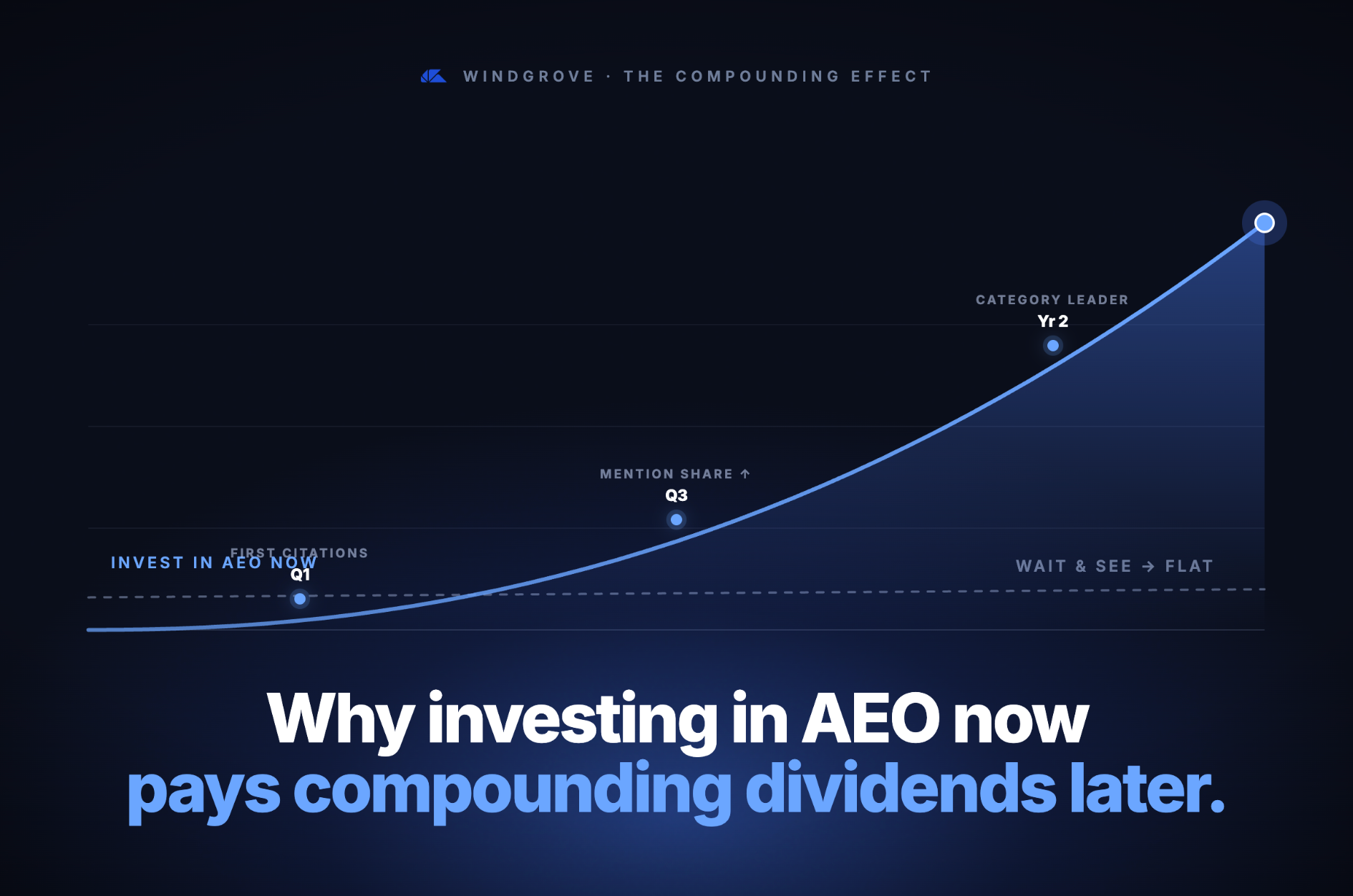
Most B2B founders treating AEO as a future priority are making a strategic error. Not because AI search is a fad, but because of how entrenched positions form. The brands that become the cited answer in ChatGPT, Perplexity, and Google AI Overviews today are building a moat that gets harder to cross with every passing quarter. The brands waiting to "see how this plays out" are watching that moat fill.
This article makes the case for why AEO is a timing-sensitive revenue decision, not a marketing experiment. It draws on data from over 680 million AI citations, 4,000+ buyer surveys, and conversion studies across multiple AI platforms to show what early movers are already gaining and what late movers will spend years trying to recover.
Executive SummaryCitation positions entrench quickly. AI engines develop strong preferences for established sources, and displacing a cited brand requires sustained effort over months. Every quarter you delay, a competitor has a chance to claim your category.Your buyers are already using AI to research. 73% of B2B buyers now use AI tools like ChatGPT and Perplexity in their purchase research, and Forrester's 2025 Buyers' Journey Survey found that 61% of the buying journey completes before any vendor contact.AI-referred traffic converts at 5x the rate of organic search. Visitors arriving via AI citations convert at 14.2% versus 2.8% for Google organic, because the AI has already filtered, compared, and pre-qualified them before they click through to your site.The adoption gap is a narrow window. Only 20% of organisations have begun implementing AEO, despite 70% believing it will significantly impact their strategy within three years. The first movers in your category are capturing disproportionate share right now.
The Search Landscape Has Already Shifted
AEO is Answer Engine Optimization: the practice of structuring your brand's content and authority so that AI-powered platforms select you as a cited source when generating answers. It is not a replacement for SEO. It is the layer on top of SEO that determines whether your brand gets included in the answer, or simply ranked somewhere on a page the AI summarises without mentioning you.
The scale of the shift is no longer speculative. ChatGPT alone now handles over 2 billion queries daily, and AI-referred sessions to websites grew 527% year-over-year through mid-2025. Google AI Overviews now appear for 13.14% of all search queries. Perplexity, Claude, and Gemini are each processing hundreds of millions of queries per month. For B2B buyers in particular, this is where the research is happening.
The critical distinction: Google ranks pages. AI engines synthesise answers. When a buyer asks Google "best logistics software for mid-market companies," they get ten blue links. When they ask ChatGPT the same question, they get a curated recommendation with specific vendor names, reasons why, and comparisons. Your brand either appears in that answer or it does not. There is no page two.
What AEO is not
AEO is not about gaming AI systems or stuffing content with keywords. It is about becoming genuinely authoritative on the questions your buyers are already asking AI tools. The brands that get cited consistently are those with clear, structured, evidence-backed content that AI engines can extract and trust. That takes time to build. Which is exactly why starting later is more expensive than starting now.
Citation Positions Entrench. Displacement Is Expensive.
This is the argument most AEO coverage misses. The discussion tends to focus on visibility: "get cited so buyers see you." That is true, but it understates the real strategic risk. The deeper issue is that AI citation positions, once established, are self-reinforcing and difficult to displace.
AI engines are trained on the web and updated continuously, but their citation preferences are not random. They favour sources with demonstrated topical authority, consistent presence across multiple trusted platforms, and a track record of being cited by other authoritative sources. The longer a brand has been building that signal, the harder it is for a newcomer to outcompete it on the same queries. This is the same compounding dynamic that made early SEO movers so hard to displace on high-value keywords, but compressed into a shorter window.
The adoption gap is the opportunity
Right now, only 20% of organisations have begun implementing AEO, despite 70% believing it will significantly reshape their digital strategy within three years. That gap is your window. In most B2B categories, the answer-engine landscape is still wide open. No brand has yet locked in the citation position for your most valuable buyer queries.
That window is closing. The brands moving now are building topical authority month over month. Every piece of structured, citable content they publish is another signal to AI engines that they are the authoritative source in their category. By the time the 80% who are waiting decide to act, they will not be starting from zero. They will be starting from behind.
The cost of delay compounds
Consider what happens when a competitor establishes citation authority in your category six months before you start. They are being recommended in buyer research conversations. Their brand name is being repeated in AI-generated shortlists. Buyers arrive at their demo calls already familiar with their positioning. Meanwhile, you are invisible in those same conversations. Catching up requires not just matching their content and authority signals, but exceeding them enough to displace an already-trusted source. That is a much harder and more expensive problem than simply showing up first.
The uncomfortable truth: inaction is not a neutral position. Every month without an AEO strategy is a month in which a competitor can claim the answer position in your category. And once they hold it, the cost to reclaim it is significantly higher than the cost of claiming it first.
Your Buyers Are Already Pre-Sold Before They Contact You
Here is what changes when AEO is working: by the time a buyer books a demo, they have already been through a research process in which your brand was the recommended answer. They arrive knowing your positioning. They have read the AI's summary of your strengths. They have already had your brand compared favourably against alternatives. The sales conversation starts at a different point entirely.
This is not a hypothetical. The data on how B2B buyers now research is unambiguous.
The buyer journey has moved to AI
According to a 2026 multi-source analysis by Loganix covering 680 million AI citations and 2,961 controlled research sessions, 73% of B2B buyers now use AI tools like ChatGPT and Perplexity in their purchase research process. That figure comes from Averi's March 2026 analysis and represents a decisive shift from experimental to habitual behaviour.
Forrester's 2025 Buyers' Journey Survey of 4,000+ buyers found that generative AI tools were the single most cited meaningful interaction type for researching purchases. More significantly, 61% of the buying journey now completes before any vendor contact. Buyers are building their shortlists, comparing features, evaluating pricing, and forming vendor preferences entirely through AI-assisted research. By the time they reach out, the decision is often nearly made.
G2's 2025 Buyer Behaviour Report, based on 1,169 B2B decision-makers, found that nearly two out of three buyers now prefer engaging with vendor salespeople only in the later stages of their buying journey, up 17 percentage points from the prior year. About 1 in 10 buyers skip the shortlist process entirely and land on a single vendor to submit for approvals.
What this means for your sales team
When your brand is consistently cited in AI answers for the queries your buyers are asking, your sales team inherits a different kind of inbound lead. The buyer has context. They have been pre-qualified by the AI's synthesis. They are not arriving cold, asking basic questions about what you do. They are arriving warm, asking specific questions about implementation, pricing, and fit.
Research from Ahrefs found that only 0.5% of their website visitors came from AI search, yet those visitors accounted for over 12% of signups. That is a conversion rate 23 times higher than their normal baseline. HubSpot reported 3x better lead conversion from AEO-sourced traffic than from other channels. These are not outliers. They reflect a structural difference in intent: AI-referred visitors have already been through a recommendation process before they arrive.
Traffic Source | Conversion Rate | Relative Performance |
|---|---|---|
Google Organic | 2.8% | Baseline |
AI Search (average) | 14.2% | 5.1x higher |
Claude specifically | 16.8% | 6x higher |
ChatGPT specifically | 14.2% | 5.1x higher |
Perplexity specifically | 12.4% | 4.4x higher |
Source: Exposure Ninja conversion rate analysis, March 2026
The Washington Post reported that AI platform visitors have a 4–5x higher subscription conversion rate versus traditional search, a figure its Chief Revenue Officer attributed directly to the pre-qualification effect of AI-driven recommendations. The same dynamic applies in B2B: the AI has done the discovery work before the buyer ever lands on your site.
AEO Creates a Halo Effect Across Every Channel
One of the least-discussed benefits of AEO is that citation visibility does not stay contained to AI-referred traffic. Being cited in AI Overviews and conversational answers creates a halo effect that lifts performance across all of your marketing channels.
Research shows that websites cited within Google AI Overviews enjoy 35% higher organic click-through rates and 91% higher paid CTRs compared to non-cited pages. The mechanism is straightforward: a buyer sees your brand recommended in an AI answer, then later searches your brand name directly, or clicks your paid ad with higher confidence because they already recognise you as an authority. The citation creates trust that carries over into every subsequent touchpoint.
Brand mentions outperform backlinks for AI citation
The signals driving AI visibility differ meaningfully from those driving traditional search rankings. A 2026 B2B AI Buying Behavior Analysis found that brand mentions correlate 3x more strongly with AI citation than backlinks. This matters because it changes where you invest. Link building remains important for the search infrastructure that feeds AI retrieval systems, but the strongest single predictor of whether your brand appears in AI answers is how frequently it is mentioned across authoritative web sources, regardless of whether those mentions include a hyperlink.
Share of voice is a zero-sum game
AI engines cite a limited number of sources per answer. Perplexity cites approximately 6.6 sources per answer, Gemini around 6.1, and ChatGPT only 2.6, according to a study of 40,000 AI answers by xfunnel.ai. In a category with ten competing vendors, only two or three brands will be cited in any given answer. The brands that invest in AEO now are competing for those slots while most of their competitors are absent. The brands that wait will find those slots occupied when they eventually arrive.
Share of voice in AI answers is not additive. It is competitive. Every citation your competitor earns in your category is one you did not.
This framing matters for founders thinking about AEO as a "nice to have." It is not. It is a competitive position that either you hold or someone else holds. The category answer slot does not stay empty while you decide.
What the ROI Actually Looks Like
Founders are right to ask for numbers before committing budget. The ROI of AEO shows up in three places: direct AI-referred traffic that converts at 5x the organic rate, AI-influenced conversions that surface as branded search and direct traffic lifts, and a halo effect that improves CTR across paid and organic channels.
A worked example
Consider a B2B SaaS company with a $25,000 average contract value investing $10,000 per month in AEO. Based on conversion benchmarks from Exposure Ninja's March 2026 analysis:
- AI-referred demo requests (tracked): 12 per month
- AI-influenced demo requests (via branded search lift): 8 per month
- Total AI-attributed demos: 20 per month
- Demo-to-close rate: 30%
- Monthly revenue: $150,000
- ROI: ($150,000 - $10,000) / $10,000 = 1,400%
The "AI-influenced" number requires attribution modelling beyond last-click. When your direct traffic conversion rate rises from 8% to 12%, that 4-percentage-point lift reflects AI-informed visitors arriving with more context, having already encountered your brand in an answer engine earlier in their research.
The zero-click influence problem
Not every AI citation produces a click. Many buyers read the AI's answer and form a vendor preference without ever visiting your site. This is not a failure mode. It is a different kind of influence: your brand shapes the buyer's mental shortlist before they interact with your funnel at all. The conversion happens later, through a different channel, and looks like direct traffic or branded search. Traditional attribution misses it entirely.
**The correct question is not "how much traffic did AEO send us?" It is "how many buyers formed a preference for our brand because AI recommended us?"**arger, and it is the one that matters for revenue.
What a B2B Buyer Actually Sees in an AI Answer Engine
When a B2B buyer asks an AI engine for a vendor recommendation, they receive a synthesised answer with cited sources, not a list of blue links. The screenshot below shows this experience in action on Perplexity. The brands cited are the ones that have invested in AEO. The brands not cited are invisible, regardless of how well they rank in traditional search.
This is the buyer experience your AEO investment is competing for. Only 12% of URLs cited by AI engines overlap with Google's top-10 organic results, according to a study of 15,000 prompts using Ahrefs Brand Radar. Ranking well in traditional search does not guarantee citation in AI answers. They are separate competitions, and the AI competition is the one your buyers are increasingly using first.
The Window Is Open. It Will Not Stay That Way.
AEO is not a trend to monitor. It is a competitive position to claim before someone else does. The research is clear: 73% of your buyers are already using AI tools to research vendors, 61% of their journey completes before they contact you, and the brands cited in those AI answers convert at 5x the rate of traditional organic traffic.
The window is open because most of your competitors have not started. According to Acquia's research, 70% of organisations believe AEO will significantly impact their strategy, but only 20% have begun implementing it. That gap is the opportunity. It will not last.
The founders who move now will spend the next twelve months building the citation authority, topical depth, and brand mention signals that make AI engines trust and recommend them. The founders who wait will spend those same twelve months watching competitors entrench, then face the much harder problem of displacement.
The question is not whether AEO matters. The question is whether you act before or after your category's answer positions are taken.
Frequently Asked Questions
How is AEO different from SEO?
SEO optimises your content so that search engines rank your pages highly in a list of results. AEO optimises your brand and content so that AI engines cite you directly in the answers they generate. The two disciplines overlap, but they are not the same. A page can rank well in Google and still be invisible in ChatGPT or Perplexity, because only 12% of URLs cited by AI engines appear in Google's top-10 results. Both matter, but they require different investments and measure success differently.
How long does it take to see results from AEO?
AEO is a compounding investment, not a quick-win channel. Most brands begin seeing measurable AI citation activity within three to six months of structured implementation, with meaningful pipeline influence appearing at the six-to-twelve-month mark. The timeline depends on the competitiveness of your category and how much topical authority you are starting with. Starting earlier compresses this timeline and raises the ceiling.
Can a small B2B company compete with larger brands in AI citations?
Yes, and more easily than in traditional SEO. AI engines favour content quality, structural clarity, and topical depth over domain authority alone. A study of 40,000 AI answers found that 82.5% of AI citations link to deeply nested content pages, not brand homepages. A focused, well-structured content programme targeting specific buyer queries can earn citations that outperform much larger, better-funded competitors who have not yet optimised for AI retrieval.
What does AEO investment actually involve?
AEO requires work across several areas: structuring content so AI engines can extract clear answers, building topical authority through depth and consistency, earning brand mentions across authoritative third-party sources, implementing schema markup, and tracking citation performance across AI platforms. It is not a single tactic. It is a systematic programme that builds compounding authority over time, which is why starting earlier produces better long-term returns.
How do I measure whether AEO is working?
Measure AEO through a combination of direct and indirect signals. Direct signals include AI-referred sessions in your analytics (filter by referrer domains such as chatgpt.com, perplexity.ai, claude.ai), citation tracking using tools like Profound or Peec.ai, and share-of-voice comparisons against competitors. Indirect signals include branded search volume growth, direct traffic conversion rate improvements, and sales-qualified lead quality from inbound. Traditional last-click attribution will undercount AEO's value. Multi-touch models that account for AI-influenced touchpoints earlier in the buyer journey give a more accurate picture.