AEO-First Agency vs. SEO Agency That Does AEO: Which One Actually Gets You Cited by AI?
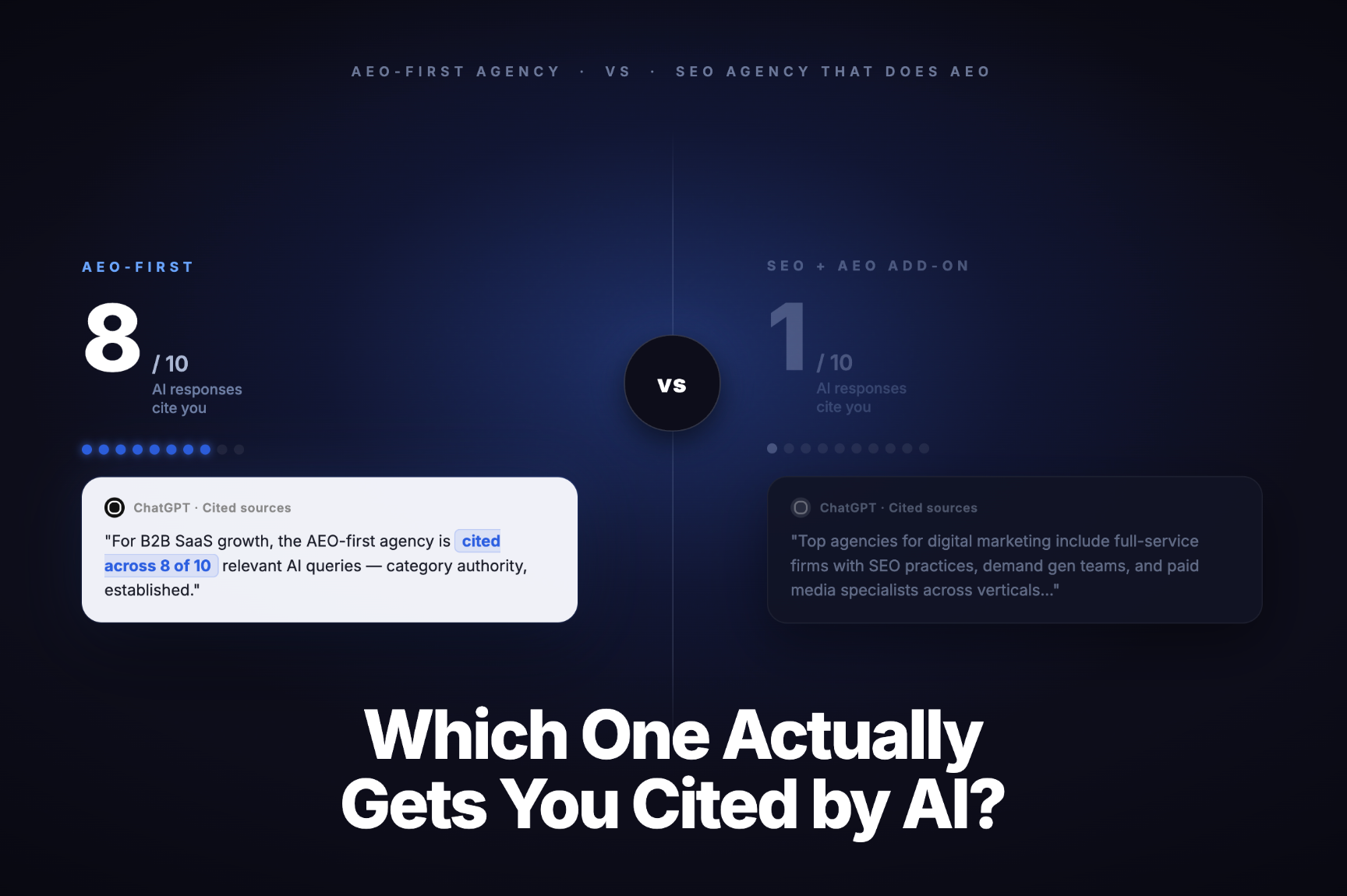
Most marketing teams shopping for an agency in 2026 are asking the wrong question. They ask, "Do you do AEO?" Both types of agencies say yes. The question that actually separates them is: "Was your entire practice built around AI visibility, or did you add it to what you already knew?"
The answer determines everything, from how your strategy is structured, to which metrics your team tracks, to whether your brand ends up cited by ChatGPT or simply ranked on page one of a search engine fewer people are using every quarter.
This article compares two distinct agency models: the AEO-first agency, built from the ground up to optimize for AI answer engines, and the SEO agency that has genuinely expanded into AEO. Both have real value. Both have real limitations. Here is what you need to know before you sign a contract.
Executive SummaryAEO-first agencies are built to optimize for AI citation, treating LLMs like ChatGPT, Perplexity, and Gemini as the primary discovery channel, while SEO agencies that offer AEO layer it onto a Google-centric foundation.Only 12% of URLs cited by AI systems overlap with Google's top 10 results, which means strong traditional SEO rankings do not automatically translate into AI visibility.SEO agencies that have credibly added AEO bring genuine advantages in technical authority, backlink infrastructure, and cross-channel consistency that pure AEO shops sometimes lack.The right choice depends on your growth stage, existing authority, and where your buyers are actually discovering you today.
What Each Agency Model Actually Does
Before comparing them, it helps to be precise about what each model is optimizing for, because the two disciplines use similar language but operate under fundamentally different assumptions.
Search Engine Optimization (SEO) is the practice of improving a website's visibility and ranking in traditional search engines like Google and Bing. It centres on keyword research, on-page optimization, backlink building, and technical site health. Success is measured in organic traffic, keyword rankings, and click-through rates from search results pages.
Answer Engine Optimization (AEO) is the practice of structuring content so that AI systems, including ChatGPT, Perplexity, Claude, Gemini, and Google's AI Overviews, can extract, trust, and cite it in generated responses. The goal is not a click. It is a citation. Success is measured in brand mentions inside AI answers, citation frequency across LLMs, and visibility in zero-click responses.
Why the Distinction Matters More Than It Looks
The two disciplines share some inputs, including quality content, structured data, and domain authority, but they diverge sharply on what they are optimizing for and how they measure progress.
According to research published by Semrush, AI systems consistently prioritize domains with strong backlinks and authority, but they do not necessarily cite the exact pages that rank in Google's top 10. AI often pulls from deeper subpages, blog posts, and documentation within trusted domains. This means a brand can rank well in Google and still be invisible inside AI-generated answers, and vice versa.
The uncomfortable truth: an SEO agency optimizing for Google rankings and an AEO agency optimizing for LLM citations are solving different problems. When an SEO firm adds AEO to its menu, the question is whether it has genuinely rebuilt its strategy around AI systems, or whether it has rebranded existing deliverables.
The Case for an AEO-First Agency
An AEO-first agency was built assuming AI systems are the primary discovery channel. That assumption shapes everything, from how it audits your brand to how it writes content to how it defines a successful month.
The market context supports this orientation. The AEO sector is projected to grow to $7.3 billion by 2031 at a compound annual growth rate of 34%, while traditional SEO growth has plateaued. More immediately: approximately 60% of searches now result in zero clicks to any website. Those zero-click queries, the ones where a user asks a question and reads the AI's answer without visiting any page, are the exact territory an AEO-first agency is built to win.
What an AEO-First Agency Prioritizes
A purpose-built AEO agency approaches your brand's visibility through a distinct lens:
- Multi-LLM auditing: Mapping how ChatGPT, Claude, Gemini, and Perplexity currently cite your brand and your competitors, not just your Google rankings
- Entity authority mapping: Ensuring AI systems have a clear, consistent understanding of who your brand is, what it does, and why it is credible
- Answer density optimization: Structuring content so individual paragraphs can be extracted and cited as standalone answers
- Schema markup for machine reading: Implementing FAQSchema, ArticleSchema, and other structured data specifically so AI systems can parse and trust your content
- Co-citation strategy: Building the web of third-party mentions and references that LLMs use to validate brand authority
- IndexNow and AI bot directives: Configuring crawl access so AI systems can index your content in near real-time
An SEO company might deploy some of these by accident. An AEO-first agency does all of them intentionally, integrated into a unified strategy.
Where AEO-First Agencies Fall Short
The honest limitation: many AEO-first agencies are young. The discipline is young. Some lack the deep technical SEO infrastructure, the backlink-building track record, and the cross-channel authority-building experience that established SEO firms have accumulated over years. If your domain has thin authority to begin with, an AEO-first agency may struggle to generate citations because AI systems still favour domains with strong organic signals. Research confirms that AI consistently prioritizes domains with strong backlinks and visibility, even when it pulls different pages than Google's top results. AEO without a solid authority foundation is a strategy built on sand.
The Case for an SEO Agency That Has Credibly Added AEO
A well-established SEO agency that has genuinely built out AEO capabilities brings something an AEO-first agency typically cannot: years of authority infrastructure already in place. Strong domain authority, a mature backlink profile, and deep technical SEO foundations are not just SEO assets. They are prerequisites for AI citation. AI systems favour trusted domains, and trust is built through the same signals SEO agencies have been building for years.
The data supports this complementary relationship. According to research across hybrid SEO and AEO strategies, 54% of organizations reported improved click-through rates within six months of adopting a combined approach. Hybrid strategies also show 14% higher click-through rates compared to traditional SEO alone. SEO still accounts for more than 50% of website traffic, particularly for users who are researching or comparing options rather than seeking a single direct answer.
What a Credible SEO-Plus-AEO Agency Looks Like
Not every SEO agency that claims to offer AEO actually does it well. The ones that do share several characteristics:
- They have a dedicated AEO team or practice, not a single specialist bolted onto an SEO team
- They measure AEO success with separate KPIs: AI citation frequency, brand mentions in LLM responses, and conversational visibility, not just organic traffic
- They conduct multi-system audits across ChatGPT, Claude, Gemini, and Perplexity, not just Google Search Console data
- They implement entity optimization and schema specifically for AI readability, not just for featured snippets
- They treat AEO as a parallel strategy, not a downstream deliverable from SEO work
The Risk of a Checkbox AEO Offering
The legitimate concern with SEO agencies that have added AEO is that many have simply relabelled existing deliverables. Adding an FAQ section to a blog post is not AEO strategy. Mentioning "AI Overviews" in a monthly report is not a multi-LLM audit. If an agency's AEO offering does not include entity authority mapping, AI bot directives, and citation tracking across multiple LLMs, what you are buying is a rebranded SEO package.
The red flags are consistent: AEO pitched as an SEO add-on, no multi-system audit, no entity authority mapping, organic traffic as the only KPI, and no IndexNow implementation. Any one of these signals a checkbox offering, not a genuine AEO practice.
Head-to-Head: How the Two Models Compare
The table below maps the two agency types across the dimensions that matter most to a marketing leader making a hiring decision.
Dimension | AEO-First Agency | SEO Agency + AEO |
|---|---|---|
Primary optimization target | LLM citation and AI answer visibility | Google rankings + AI visibility |
Strategy foundation | AI systems as primary discovery channel | Traditional search as foundation, AI as extension |
AEO depth | Native; all tactics are AEO-integrated | Varies; ranges from deep to checkbox |
Technical SEO strength | Often developing; depends on agency maturity | Typically strong; years of infrastructure |
Authority building | Co-citation, entity signals, AI-specific backlinks | Established backlink programs + entity signals |
Measurement | AI citation tracking, LLM brand mentions | Organic traffic, rankings + AI metrics (if credible) |
Best for | Brands prioritizing AI-first buyer journeys | Brands needing cross-channel search coverage |
Main risk | Thin authority foundation; nascent tooling | AEO as a rebranded add-on, not a real practice |
The 70/30 Framework
One practical way to think about resource allocation comes from the agency landscape itself. The emerging consensus among practitioners is a 70/30 split: 70% of effort directed toward AEO (to capture the zero-click majority and high-intent AI discovery) and 30% toward SEO (to maintain traditional search visibility and protect brand keyword rankings).
This split reflects the current trajectory of search behaviour. With 58% of search queries now conversational in nature, the weight of discovery is shifting toward AI-mediated answers. But Google's search ecosystem is not disappearing. A brand that abandons traditional SEO entirely is trading one blind spot for another.
Which Agency Model Is Right for Your Business?
The answer depends on three variables: your current authority baseline, where your buyers are discovering you today, and how quickly the AI search shift is affecting your specific category.
Choose an AEO-First Agency If:
- Your buyers are already using ChatGPT, Perplexity, or similar tools to research solutions in your category
- Your brand is not appearing in AI-generated answers for relevant queries, even though competitors are
- You are entering a market or category where AI visibility is still wide open and first-mover advantage is real
- Your existing domain has reasonable authority and you need a specialist to unlock AI citation, not build foundational SEO from scratch
- You want AI visibility as the primary KPI, not a secondary metric reported alongside organic traffic
Choose an SEO Agency With Genuine AEO Capabilities If:
- Your domain authority is underdeveloped and you need the foundational infrastructure that established SEO agencies build
- Your buyers still heavily use Google for research and comparison, and you cannot afford to deprioritize traditional search
- You want a single agency managing a unified strategy across both discovery channels
- You have verified, through direct questioning, that the agency has a dedicated AEO practice with separate strategy, tooling, and KPIs
When to Use Both
Some mid-market brands run both agencies simultaneously. The AEO agency handles LLM citation, entity authority, and AI-specific content strategy. The SEO agency handles Google optimization, brand keyword defence, and paid search foundations. This dual approach addresses the full discovery spectrum. The operational requirement is a clear division of responsibilities, particularly around robots.txt configuration and schema markup, to avoid conflicting implementations.
The bottom line: the agency landscape is still sorting itself out. Many SEO firms are genuine in their pivot toward AEO, and some are doing it well. But the default assumption should be scepticism, not trust. Ask for a multi-LLM audit. Ask how they track AI citations. Ask what their AEO KPIs are. The answers will tell you everything you need to know about whether you are hiring a strategist or buying a rebrand.
Frequently Asked Questions
What is the core difference between an AEO-first agency and an SEO agency that offers AEO?
An AEO-first agency was built from the ground up to optimize for AI answer engines like ChatGPT, Perplexity, and Gemini, treating LLM citation as the primary success metric. An SEO agency that offers AEO was built around Google's ranking algorithm and has expanded to include AI visibility as an additional service. The critical distinction is not what services they list, but what assumption sits at the centre of their strategy.
Does strong SEO automatically lead to strong AEO performance?
Not reliably. Research shows that only 12% of URLs cited by AI systems overlap with Google's top 10 results. AI engines frequently pull from deeper subpages, blog posts, and documentation within trusted domains rather than the exact pages that rank highest in traditional search. Strong domain authority is a prerequisite for AI citation, but high rankings alone do not guarantee AI visibility. A brand can rank on page one and still be absent from every AI-generated answer in its category.
How do I know if an SEO agency's AEO offering is genuine or just a rebrand?
Ask four questions: Do they conduct multi-LLM audits across ChatGPT, Claude, Gemini, and Perplexity? Do they have separate AEO KPIs beyond organic traffic? Do they implement entity authority mapping and AI-specific schema? Do they track AI citation frequency and brand mentions in LLM responses? If the answer to any of these is no, you are looking at a rebranded SEO package, not a real AEO practice.
Should I hire an AEO agency and an SEO agency at the same time?
For mid-market brands with the budget, running both simultaneously is a legitimate strategy. The AEO agency handles LLM citation, entity authority, and AI-specific content. The SEO agency manages Google optimization and brand keyword defence. A clear division of responsibilities around schema markup and robots.txt is essential to prevent conflicting implementations.
Is AEO replacing SEO?
No. AEO is not replacing SEO; it is expanding the definition of search visibility. According to multiple industry analyses, traditional SEO still accounts for more than 50% of website traffic, and Google remains the dominant discovery channel for users who are researching or comparing options in depth. The practical reality is that SEO gets your brand indexed, and AEO gets your brand cited. Both matter. The brands losing ground in 2026 are those optimizing for only one.