How AI Search Engines Recommend B2B Companies
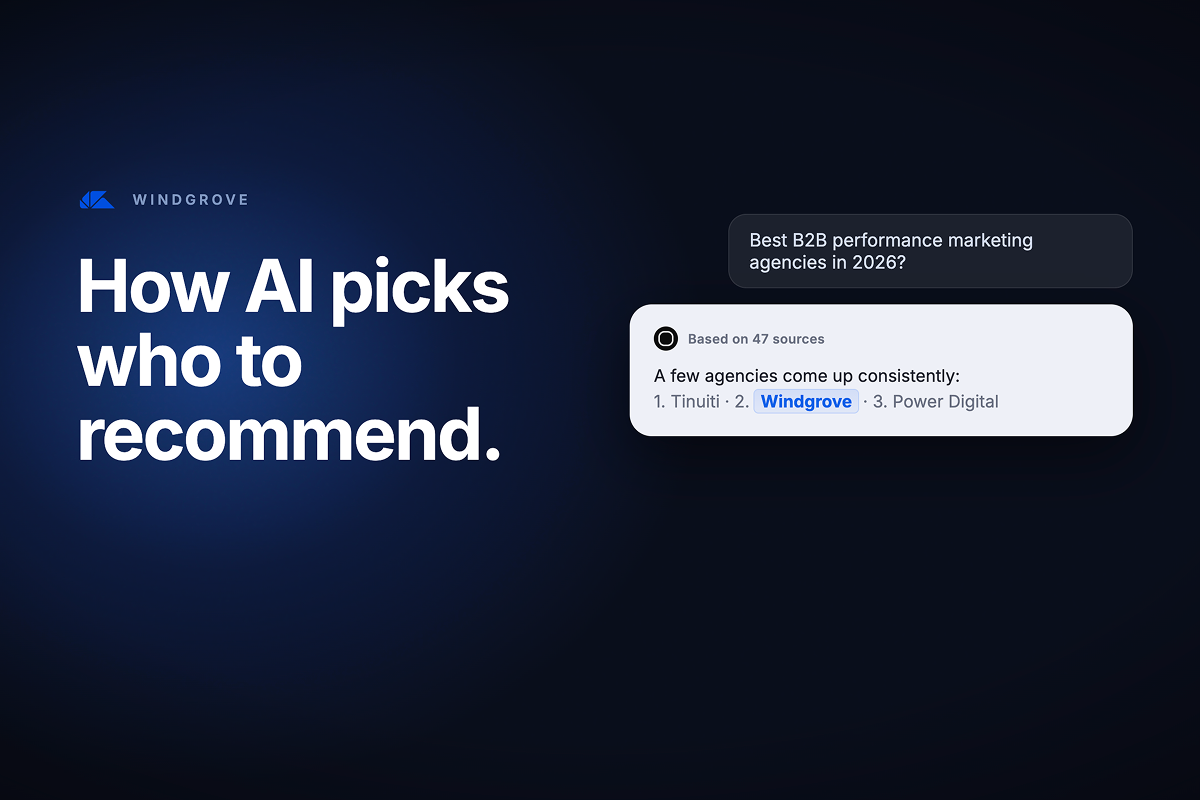
(And Why Most Are Invisible)
Your next B2B customer is probably asking an AI right now which vendor to use. Not searching Google. Not scrolling LinkedIn. Asking ChatGPT, Perplexity, or Claude a question like: "What's the best CRM for a 50-person SaaS company?" or "Which marketing automation platform integrates with Salesforce?"
If your company isn't in the answer, you don't exist for that buyer.
The shift is already here. According to a HubSpot survey of B2B buyers, 48% now use AI search while evaluating vendors. A separate survey by Responsive found that 80% of tech buyers rely on generative AI at least as much as traditional search to research vendors. These aren't early adopters anymore — this is mainstream buying behaviour.
The problem is that most B2B companies are still optimizing for Google while their prospects have already moved on. And the rules for showing up in AI answers are fundamentally different from the rules for ranking in search.
This article explains how AI search engines actually decide which companies to recommend — and what you can do to make sure yours is one of them.
AI Search Is Not Just Faster Google
Most founders assume AI search works like Google with a chatbot interface on top. It doesn't. The underlying mechanics are completely different, and that distinction determines whether your company gets recommended or ignored.
Google ranks pages. AI engines synthesize answers.
When a buyer asks Google "best project management software for agencies," they get a list of ten blue links and decide where to click. When they ask ChatGPT the same question, they get a personalized, conversational recommendation — often with specific vendor names, reasons why, and comparisons — all generated from the AI's internal understanding of the market.
That internal understanding is built from everything the model has been trained on: your website, yes, but also third-party publications, review platforms, directories, community forums, and industry databases. The AI is not crawling the web in real time for most queries. It is drawing on a synthesized model of your brand's reputation across the entire digital ecosystem.
The key insight: Your website is your resume. AI search is calling your references. What third parties say about you matters far more than what you say about yourself.
There is also a critical overlap problem. Research shows that only about 12% of URLs cited by AI engines sit in Google's top 10 for the same query. That means strong SEO rankings and strong AI visibility are largely independent outcomes. A company can dominate Google and be invisible to AI — and increasingly, that is exactly what is happening.
How LLMs Actually Decide Who to Recommend
When a B2B buyer asks an AI assistant to recommend a vendor, the model runs through a layered decision process. Understanding each layer is the first step to influencing the outcome.
Step 1: Entity Recognition
AI models think in terms of entities and relationships, not keywords. Before recommending your company, the model needs to "know" you exist as a distinct, clearly defined entity in your category. This means your brand name, what you do, who you serve, and how you relate to other known entities (competitors, integrations, categories) must be consistently represented across the web.
Inconsistent naming, vague positioning, or a thin digital footprint causes the model to either ignore your brand or misrepresent it. One common failure mode: a company appears in AI answers but is described in the wrong category or with outdated information because the model has conflicting signals.
Step 2: Authority and Trust Signals
Once the model recognizes your entity, it evaluates authority. This is where third-party signals dominate:
- Earned media: Coverage in respected industry publications
- Review platforms: G2, Capterra, Trustpilot, and similar sites
- Directories and databases: Crunchbase, LinkedIn, industry-specific listings
- Community mentions: Reddit threads, forums, and discussion boards
- Backlinks from authoritative domains: Signals that others vouch for your expertise
The model weights these signals to determine how confidently it can recommend you. A company with deep third-party coverage gets recommended with conviction. A company that only has its own website gets skipped.
Step 3: Relevance to the Buyer's Query
AI assistants personalize answers based on the specific context of the query. A buyer asking "best CRM for a bootstrapped SaaS startup" gets a different answer than one asking "enterprise CRM with HIPAA compliance." The model matches your brand to queries based on how clearly your content addresses specific use cases, company sizes, industries, and pain points.
This is why broad, generic positioning hurts AI visibility. If your content doesn't clearly signal who you're for and what problems you solve, the model can't confidently place you in the right answers.
Step 4: Freshness and Recency
AI models are regularly updated and increasingly use retrieval-augmented generation (RAG) to pull in current web content for time-sensitive queries. Brands that publish consistently, earn ongoing media coverage, and maintain active profiles across platforms signal to the model that they are current and relevant. Brands that went quiet two years ago may have strong historical training data but declining real-time signals.
Each AI Engine Has Different Priorities
Not all AI search engines work the same way. A B2B company visible in ChatGPT may be invisible in Perplexity, and vice versa. Understanding each platform's bias helps you prioritize where to focus.
AI Engine | Primary Recommendation Signal | What This Means for B2B Brands |
|---|---|---|
ChatGPT | Consensus across authoritative sources | You need to appear in multiple trusted publications, not just one |
Perplexity | Real-time web search + recency | Fresh content and recent coverage matter more than historical authority |
Google AI Overviews | Google's existing index + structured data | Schema markup and strong on-page structure amplify your existing SEO |
Claude | Training data depth + entity clarity | Clear, consistent brand definition across the web is critical |
Gemini | Google Knowledge Graph + structured data | Schema implementation has the highest priority weight (estimated 45%) |
The practical implication: A brand that appears consistently across all five platforms is far more likely to be recommended regardless of which AI a buyer happens to use. Platform-specific optimization is a second-order concern; broad authority is the foundation.
One important nuance: Perplexity runs a live web search for every query, which means it can surface newer or smaller companies that have strong recent coverage, even if they lack years of accumulated authority. For B2B companies that are earlier in their growth, this is a meaningful opportunity.
What B2B Companies Can Do About It
Understanding the mechanics is useful. Knowing what to do about them is what matters. AI visibility is not a one-time fix — it is a system that compounds over time. Here is where to start.
Build Topical Authority, Not Just Pages
AI engines favour brands that comprehensively own a topic, not brands that have one good blog post. Pick three to five core topics that directly map to your buyers' questions and build deep, interconnected content around each one. The model needs to be able to identify your brand as the authoritative source on the problems you solve.
Earn Third-Party Coverage Systematically
Your own website is the weakest signal you can send. Industry publications, analyst mentions, review platforms, and community discussions are what AI models treat as social proof. One well-placed feature in a respected industry publication generates more AI citation weight than twenty blog posts on your own site.
Establish Clear Entity Signals
Use your exact brand name consistently across every platform — your website, LinkedIn, Crunchbase, G2, industry directories, and press mentions. Inconsistency creates ambiguity. Ambiguity means the model either skips you or misrepresents you.
Structure Your Content for AI Extraction
AI engines extract specific passages from your content to use in answers. Each section of your content should open with a clear, direct answer to a specific buyer question — not a preamble. Content structured around questions that buyers actually ask in AI prompts ("What is the best [category] for [use case]?") is far more likely to be quoted directly.
Monitor Your Visibility Across Platforms
Most B2B companies have no idea how they appear in AI answers right now. Running your ten most important buyer queries through ChatGPT, Perplexity, Claude, and Google AI Overviews monthly is the minimum baseline. Track whether you appear, how you are described, and which competitors are being recommended instead of you.
The first-mover advantage is real. LLM perception drift, the month-over-month shift in how AI models position brands in a category, is already reshaping B2B markets. Research from Search Engine Land shows that brands like Atlassian gained significant AI visibility scores in a single month while established competitors dropped — purely based on which brands had stronger semantic anchoring in the model's training data.
Companies that build AI visibility now are compounding an advantage that will be very difficult to close in two years.
The Window Is Open — For Now
AI search is not a future trend to monitor. It is an active buying channel where your prospects are building shortlists today. The mechanics favour companies that move early: AI models develop brand associations over time, and those associations are sticky. Brands that establish strong entity signals and third-party authority now will be the default recommendations in their categories by 2027.
The good news for B2B companies is that most of your competitors haven't started. The AI visibility landscape in most B2B categories is still wide open. That is a narrow window.
If you want to understand where your company stands right now — which queries you appear in, how you're described, and what it would take to move up — Windgrove AI offers AI visibility audits specifically built for B2B companies. It's the fastest way to see your current position and build a roadmap to own it.