HowTo vs Article Schema: Which One Gets You Cited by AI Engines?
Executive Summary
HowTo schema and Article schema send fundamentally different signals to AI engines. Applying the wrong one to your content is one of the most common and costly structured data mistakes.
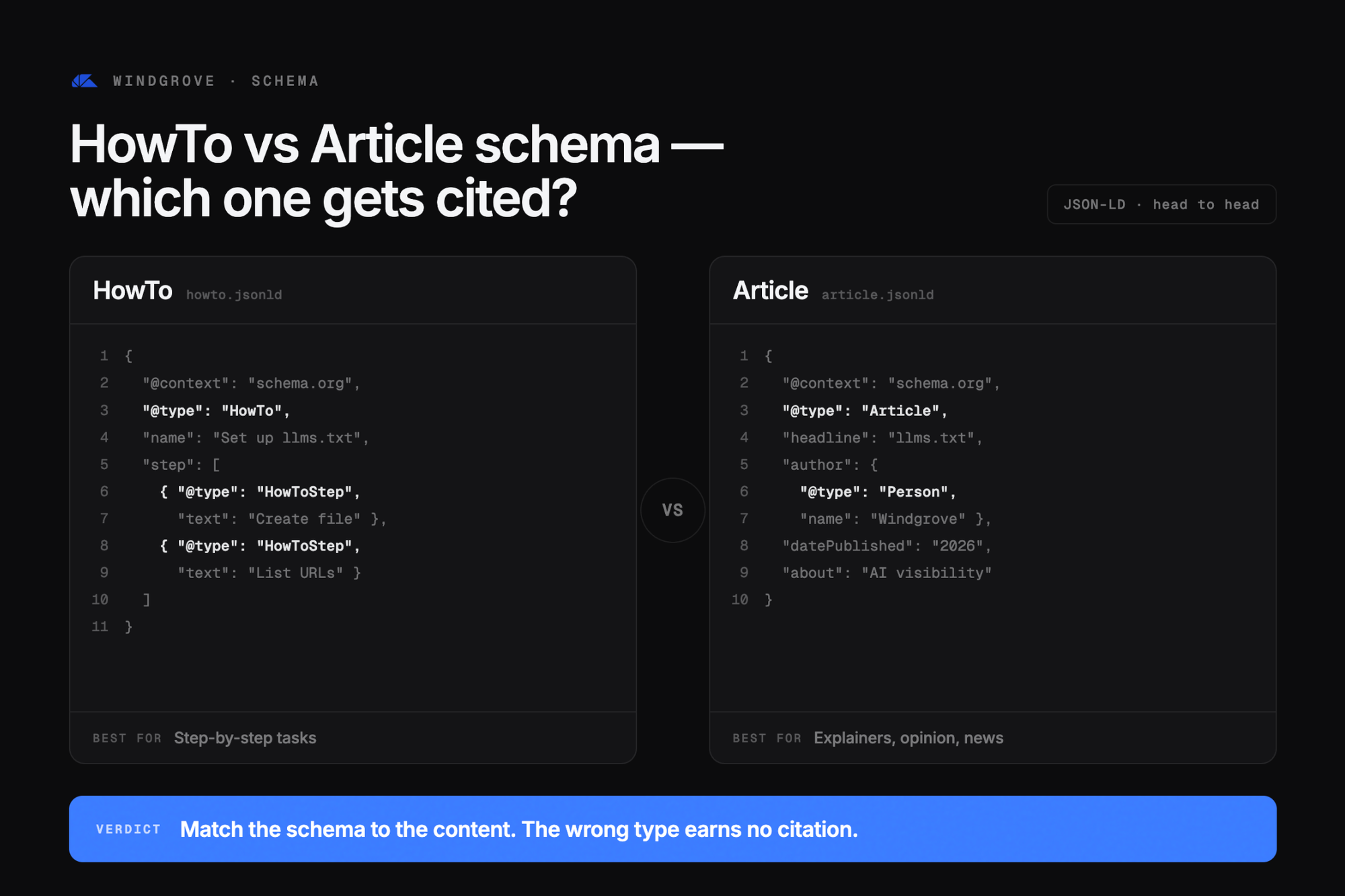
HowTo schema is built for procedural, step-by-step content. Article schema is built for editorial, informational content. The distinction is not cosmetic. It changes how AI engines extract, interpret, and cite your pages.
Pages with schema markup are 3x more likely to earn AI citations than pages without it. But generic or misapplied schema can actively underperform having no schema at all.
Windgrove's AEO audits include a full structured data review across every core page, identifying missing schema, misapplied types, and the specific fixes that move your AI visibility score.
Most content teams treat schema markup as a box to tick. Add it once, validate it in Google's Rich Results Test, and move on.
That approach misses the point entirely.
Schema markup is not just a technical formality. It is the signal that tells AI engines what kind of content they are reading, how to extract it, and whether to cite it. When you apply the wrong schema type to a piece of content, you are not just failing to benefit from structured data. You are potentially confusing the very systems you are trying to get cited by.
The uncomfortable truth: most sites that have schema markup have the wrong schema markup. Not because they implemented it incorrectly in a technical sense, but because they applied it without understanding what each type is actually communicating to an AI engine.
This article breaks down the functional difference between HowTo and Article schema, explains when each applies, and shows what getting it right actually looks like in practice.
Why Schema Markup Matters for AI Visibility
Before getting into the specific types, it is worth understanding what schema markup actually does inside the AI citation pipeline.
AI engines like ChatGPT, Perplexity, and Google AI Overviews do not read your website the way a human does. They process structured signals. When your content has schema markup, you are not just decorating your HTML. You are giving the AI engine a machine-readable declaration of what your content covers, who created it, and how it is structured.
The mechanism: Schema feeds Google's Knowledge Graph and Bing's entity index. AI engines draw on those enriched indexes when generating answers. Your JSON-LD does not get parsed in real time by an LLM. It gets absorbed upstream, during indexing, and shapes how confidently an AI engine can cite your page.
This is why the type of schema you apply matters. Different schema types send different signals about what kind of content a page contains. An AI engine retrieving a procedural answer to a "how do I" query is looking for different structural cues than one retrieving a definition or an editorial analysis.
Schema builds clarity, not authority. That distinction is critical. Structured data alone does not make you trustworthy. It makes you legible. A credible page with correct schema gets cited more consistently. A weak page with schema gets parsed more efficiently and ignored just as quickly.
The largest independent study on schema and citation rates, conducted by Growth Marshal across 730 citations, found that attribute-rich schema earns a 61.7% citation rate. Generic, minimally populated schema actually underperforms having no schema at all, at 41.6% versus 59.8% for pages with no schema. The lesson is not "add schema." It is "add the right schema, fully populated."
What Article Schema Actually Signals
Article schema is the structured data type for editorial, informational, and long-form content. It tells AI engines: this page contains a piece of writing with a topic, an author, and a publication date. It is designed for content that explains, analyses, or informs.
For AEO specifically, the Article schema does two things that matter:
It communicates content freshness. The datePublished and dateModified properties tell AI engines when the content was created and last updated. AI systems prioritize fresh, current information. A page without these signals is treated as undated, which reduces citation confidence, particularly for time-sensitive topics.
It anchors authorship to a verifiable entity. Pairing Article schema with Person schema (via the author property) connects your content to a named individual with credentials. This feeds directly into E-E-A-T evaluation, the framework AI engines use to assess experience, expertise, authoritativeness, and trustworthiness.
When to Use Article Schema
Article schema applies to any page where the primary purpose is to inform, educate, or analyse. Common use cases include:
Blog posts and editorial content
Industry analysis and thought leadership pieces
News articles and announcements
Guides that explain a concept rather than walk through steps
Comparison of content and research summaries
Required Properties to Populate
Minimal Article schema is not enough. Populate every relevant property:
Property | What It Signals |
|---|---|
| The topic of the content |
| Who wrote it (link to a Person entity) |
| When it was first published |
| When it was last updated |
| The organization behind the content |
| A concise summary of the content |
| A representative image (required for Top Stories eligibility) |
Leaving these fields empty is not neutral. It is a signal that the content is either incomplete or unverifiable. Both outcomes reduce citation probability.
What HowTo Schema Actually Signals
HowTo schema is built for procedural content. It tells AI engines: this page contains a task that can be completed by following a defined sequence of steps. It is designed for content that guides a user through a process from start to finish.
The distinction from Article schema is not subtle. Article schema says "here is information." HowTo schema says "here is a process." AI engines treat these as fundamentally different content types and retrieve them for different kinds of queries.
The core principle: "How do I" queries trigger AI Overviews 73% of the time. HowTo schema is the structured data signal that tells AI engines your page is the answer to exactly those queries.
When a user asks ChatGPT or Perplexity "how do I set up llms.txt for my website," the AI engine is looking for ordered, extractable steps. A page with HowTo schema makes that extraction reliable. A page without it forces the AI to infer the structure from the prose, which introduces error and reduces citation confidence.
When to Use HowTo Schema
HowTo schema applies when the content describes a task with a defined beginning, middle, and end. Use it for:
Step-by-step tutorials and technical guides
Setup and configuration walkthroughs
Process documentation (onboarding flows, installation guides)
DIY instructions and how-to explainers
Any content where the primary value is in following the sequence
Required Properties to Populate
Property | What It Signals |
|---|---|
| The name of the task being explained |
| An array of |
| Tools or software required to complete the task |
| Materials or resources needed |
| Estimated time to complete |
| Cost, if applicable |
Each HowToStep should have its own name and text property. The more granular and complete the step structure, the more reliably AI engines can extract and present individual steps as standalone answers.
The Common Mistake
The most frequent error is applying Article schema to content that is actually procedural. A "how to implement schema markup" guide is not an article. It is a process. Marking it up as Article schema tells the AI engine it is reading editorial content, not a guide. The AI may still parse and cite the page, but it is working harder to do so, and the citation accuracy drops.
HowTo vs Article Schema: Side-by-Side Comparison
Here is a direct comparison of the two schema types across every dimension that matters for AEO:
Dimension | Article Schema | HowTo Schema |
|---|---|---|
Content type | Editorial, informational, analytical | Procedural, step-by-step, instructional |
Primary query match | "What is X" / "Why does X happen" | "How do I X" / "How to X" |
Key properties |
|
|
E-E-A-T signal | Strong (via author + publisher linkage) | Moderate (task-focused, less author-centric) |
AI extraction pattern | Pulls topic, summary, author credentials | Pulls individual steps as ordered sequences |
Voice search fit | Low to moderate | High (step-by-step answers suit voice delivery) |
Google rich result | Top Stories, article carousels | HowTo rich results (scaled back in 2023, still signals AI) |
Combine with | FAQPage, Person, Organization | FAQPage, VideoObject |
The Grey Area: Content That Could Be Either
Some content genuinely sits between the two types. A "guide to AEO for B2B SaaS" could be structured as either an editorial overview (Article) or a step-by-step implementation plan (HowTo). The right call depends on the dominant intent of the content.
Ask yourself: is the reader primarily trying to understand something, or trying to do something?
If they are trying to understand: use Article schema.
If they are trying to do: use HowTo schema.
When the content is genuinely both, Article schema is the safer default. You can always supplement it with FAQPage schema to capture the question-and-answer extraction layer. What you should not do is apply HowTo schema to content that does not have a clear sequential structure. AI engines will attempt to extract steps that do not exist, which produces inaccurate citations.
You Can Use Both on the Same Page
Schema types are not mutually exclusive. A page can carry Article schema at the top level and FAQPage schema for a Q&A section at the bottom. A tutorial page can carry HowTo schema for the step-by-step section and Article schema for the introductory editorial content. The key is that each schema block accurately reflects the content it is marking up. Mismatches between what the schema declares and what the page actually contains reduce citation reliability across the board.
What This Looks Like in Practice: The Opal Case Study
Schema selection decisions do not happen in isolation. They are part of a broader technical AEO infrastructure that either enables or suppresses your content's ability to be cited.
When Windgrove began working with Opal, a charge card and spend management platform for digital marketing agencies, the site had four indexed pages, no blog, and zero AI visibility. Opal was not appearing in ChatGPT, Perplexity, or Google AI Overviews for any of the queries its buyers were using.
The first workstream was entirely technical. Before a single piece of content was written, the team audited every blocker between Opal's pages and AI crawlers. That included a full structured data review: identifying which pages had no schema, which had schema applied incorrectly, and which needed specific types to match the content structure.
The results were measurable and fast.
In 31 days, Opal went from 0% AI visibility to 15.9%, accumulating 1,766 brand mentions across LLMs and the web, with zero ad spend.
Within one week of launching the Ad Pay page, Opal ranked #2 for "ad pay" and #2 for "ad spend cards." These are bottom-of-funnel, high-intent terms. The buyers searching them are not researching. They are ready to evaluate and purchase.
The structural data work was not the only factor. The content was also written specifically for AI citation, with direct answers in the opening 100 words, proper heading hierarchy, and FAQPage schema layered alongside Article schema on editorial content. But the schema implementation was the foundation. Without it, the content would have landed on a site that AI crawlers could not reliably parse.
That is the real cost of getting schema wrong. It is not just a missed optimization. It is content that works hard to get written and published, then sits invisible because the technical layer was not in place to support it.
The Broader Schema Stack: Where HowTo and Article Fit In
HowTo and Article schema are two pieces of a larger structured data strategy. Neither operates in isolation. Understanding where they sit within the full schema stack helps you make better decisions across your entire content library.
The Priority Schema Types for AEO
Schema Type | Primary Purpose | AEO Value |
|---|---|---|
FAQPage | Marks up Q&A pairs | Highest citation rate; mirrors conversational AI query structure |
HowTo | Marks up procedural, step-by-step content | High; triggers on "how do I" queries (73% of AI Overviews) |
Article / BlogPosting | Marks up editorial content | High; communicates freshness and authorship for E-E-A-T |
Organisation | Declares brand identity | Critical for entity recognition and Knowledge Graph anchoring |
Person | Declares author credentials | Feeds E-E-A-T; makes authorship machine-readable |
Product | Marks up commercial offerings | High for product-led businesses; enables pros/cons extraction |
How They Connect
The most effective AEO schema implementations do not use these types in isolation. They connect them.
An editorial article should carry:
Article schema (with headline, author, datePublished, dateModified)
Person schema linked via the author property
Organization schema linked via the publisher property
FAQPage schema if there is a Q&A section
A procedural guide should carry:
HowTo schema (with fully populated step arrays)
FAQPage schema for any supporting Q&A content
Article schema if there is substantial introductory editorial content
This layering is what Schema.org was designed for. The @id property allows you to connect entities across schema blocks, so your author entity is the same verifiable Person across every page on your site. That consistency matters. AI engines cross-reference entity signals. Inconsistent or disconnected schema reduces the confidence with which they cite you.
The bottom line: schema type selection is not a one-time decision. It is a content-by-content judgement that should be built into your publishing workflow. Every piece of content you publish should have a defined schema type before it goes live, not after.
Find Out Where Your Schema Is Failing
Most sites have a schema problem they do not know about. Missing types on key pages. Article schema applied to procedural content. HowTo schema with empty step arrays. Publisher and author fields left blank. Each of these is a signal to AI engines that your content is either unverifiable or structurally ambiguous.
The good news is that schema errors are fixable. Quickly. And the citation impact is measurable.
Start with a free AI visibility audit from Windgrove. The Windgrove audit covers your full structured data stack: which pages have schema, which types are applied, which properties are missing, and where the mismatches between schema declarations and visible content are suppressing your citation rates. You will get a clear picture of exactly what is broken and what to fix first.
If you want to go deeper, book a free consultation. Windgrove's AEO engagements start with a complete technical foundation review before any content is written or published. Schema is always Month 1 work, because content built on a weak technical foundation does not compound. It just sits there.
Schema markup is not the whole story. But it is the infrastructure layer that everything else depends on. Get it right, and your content has a real shot at being cited. Get it wrong, and you are publishing into a void.
The AI engines are not going anywhere. The question is whether your content is structured for them.
Frequently Asked Questions
What is the difference between HowTo and Article schema?
HowTo schema is for procedural, step-by-step content where the reader is trying to complete a task. Article schema is for editorial, informational, or analytical content where the reader is trying to understand something. The distinction changes how AI engines extract and cite your page.
When should I use HowTo schema?
Use HowTo schema when your content walks a reader through a defined sequence of steps from start to finish. Tutorials, setup guides, configuration walkthroughs, and installation instructions are the clearest use cases. If your content does not have real, ordered steps, do not force the schema.
When should I use Article schema?
Use Article schema for blog posts, guides, analysis, commentary, and thought leadership content. It works best when the page is meant to explain or inform rather than instruct. Populate the author, datePublished, and dateModified fields fully — these are the properties AI engines use to assess freshness and credibility.
Can I use both HowTo and Article schema on the same page?
Yes. A page can carry Article schema for the main editorial content and HowTo schema for a genuine step-by-step section within it. Each schema block must accurately reflect the content it marks up. Mismatches between what the schema declares and what the page actually contains reduce citation reliability.
Does applying the wrong schema type hurt my AI visibility?
It can. The wrong schema type tells AI engines your content is something it is not. That creates a mismatch between the query, the schema signal, and the actual content — which reduces citation confidence. Minimally populated or misapplied schema can actually underperform having no schema at all, according to research across 730 AI citations. Getting the type right, and populating every relevant property, is what moves the needle.