Why Your SaaS Competitors Are Getting Cited by AI Tools (And You're Not)
TL;DR
AI tools don't cite randomly. They pull from five specific signals: structured data, third-party validation, answer-formatted content, entity consistency, and funnel-stage coverage. Most SaaS companies have none of these in place. Here's what the gap looks like, and how to close it.
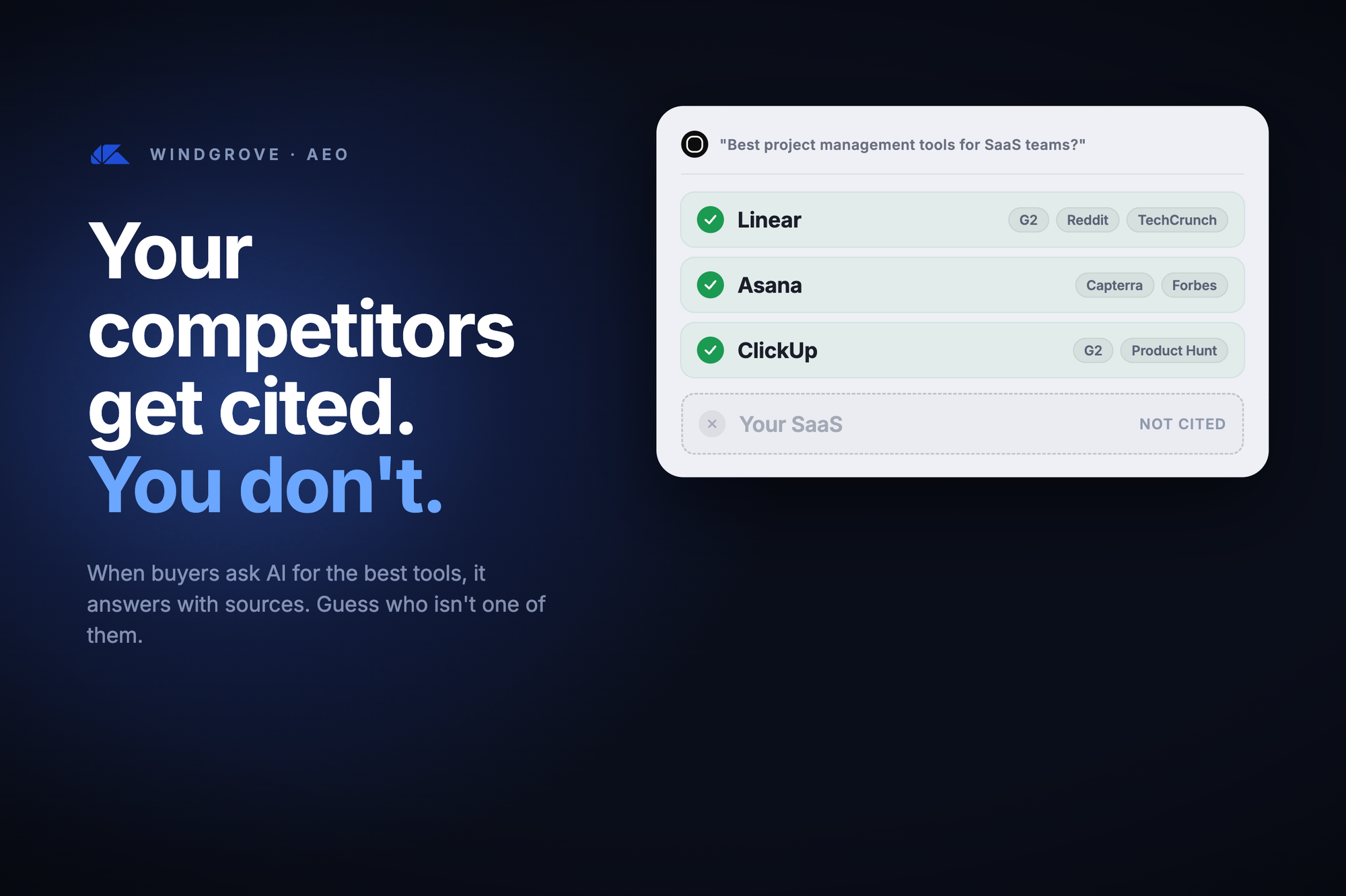
You opened ChatGPT. You typed something like "best spend management software for marketing agencies." A competitor showed up. You didn't.
It's not because their product is better. It's not because they have more blog posts. It's because they've built the signals AI engines look for when deciding who to cite — and you haven't.
That distinction matters more than almost anything else in B2B marketing right now. According to G2's 2025 buyer research, 87% of software buyers say AI answer engines changed how they research solutions, and 51% now default to AI chat for software shortlisting. Your buyer is asking ChatGPT or Perplexity for a vendor recommendation before they visit a single website.
If your brand isn't in that answer, you don't exist for that buyer.
The companies getting cited haven't necessarily out-marketed you. They've out-structured you. And the gap is more specific than most founders realise.
Why SaaS Companies Get Overlooked by AI Engines
Most SaaS companies have built their digital presence for Google. That means keyword-optimised landing pages, feature-heavy product copy, and blog posts structured to rank for search volume. None of that maps cleanly to how AI engines decide who to cite.
Google ranks pages. AI engines synthesise answers. They pull from a different set of signals entirely: structured data, third-party references, question-answering content formats, and consistent entity information across the web.
The SaaS-specific problem: product-led content doesn't answer questions.
A page that says "the most powerful spend management platform for growing teams" tells an AI engine nothing useful. A page that says "spend management software helps marketing agencies track client budgets in real time, reducing billing disputes and improving margin visibility" gives the AI something to work with.
The gap isn't content volume. Most SaaS companies have plenty of content. The gap is content structure. And underneath the content problem, there's almost always a technical problem — AI crawlers can't find the site properly, can't parse the schema, and can't establish what the company actually does.
The result: a competitor with a thinner product but a better-structured web presence gets cited. You don't.
The 5 Signals LLMs Use to Decide Who Gets Cited
AI engines don't make citation decisions arbitrarily. They weight specific signals when determining which brands are authoritative enough to recommend. Most SaaS companies are missing at least three of these five.
1. Structured Data (Schema Markup)
Schema markup tells AI engines what your content is about, who wrote it, what organisation it belongs to, and how to interpret it. Without it, the AI has to guess — and it often guesses wrong or skips you entirely.
The highest-leverage schema types for SaaS companies: FAQ schema (so individual Q&A pairs can be pulled as direct citations), Organisation schema, Article schema with author attribution, and SoftwareApplication schema on product pages.
Before AEO: No schema. The AI sees a wall of text and can't extract structured meaning.
After AEO: FAQ schema on every key page. The AI can pull a direct answer to "what does [Product] do?" without any ambiguity.
2. Answer-Formatted Content
AI engines look for a direct, extractable answer in the first 100 words of a page. If your article buries the answer 600 words in, the AI moves on to a competitor whose article leads with it.
This is where SaaS content fails most often. Blog posts are written with a narrative arc — context, problem, solution. AI engines don't read narratively. They scan for the answer.
Before AEO: Article opens with "In today's fast-moving business landscape..." The AI skips it.
After AEO: Article opens with "Spend management software helps marketing agencies track client budgets across multiple campaigns in real time." The AI cites it.
3. Third-Party Citation Footprint
AI engines require external validation before they'll confidently recommend a brand. A company that only exists on its own website will not be cited. Full stop.
For SaaS companies, this means: G2 reviews, Capterra listings, Product Hunt presence, Crunchbase profile, mentions in niche trade publications, Reddit threads in relevant subreddits, and LinkedIn company page consistency. Each of these is a citation source AI engines can cross-reference.
Before AEO: The company exists on its own domain and nowhere else credible.
After AEO: Validated across G2, Crunchbase, and three relevant publications. AI engines have external confirmation of who you are.
4. Entity Consistency
AI engines cross-reference your brand's presence across the web. If your LinkedIn says one thing, your Crunchbase says another, and your website says a third, the AI's confidence in citing you drops.
This is an invisible problem for most companies. They've updated their positioning three times in two years and never cleaned up the old descriptions across directories and profiles.
Before AEO: LinkedIn says "AI-powered analytics for e-commerce." Crunchbase says "data platform for retail." Website says "revenue intelligence for DTC brands." The AI is confused. You don't get cited.
After AEO: Consistent entity description across every platform. The AI knows exactly what you do and trusts it.
5. Funnel-Stage Coverage
Most SaaS companies have content at the top of the funnel (awareness) and almost nothing at the bottom (purchase intent). AI engines need content at every stage to recommend you throughout the buyer journey.
Someone asking "what is spend management software?" needs different content than someone asking "how do I get started with [Product]?" If you only have the first and not the second, you'll get cited for awareness queries and disappear when the buyer is ready to act.
Before AEO: 20 blog posts about industry trends. Zero content explaining how to book a demo or what onboarding looks like.
After AEO: Full funnel coverage. The AI can recommend you at the research stage, the comparison stage, and the purchase stage.
What Closing the Gap Actually Looks Like
The fix isn't a content sprint. It's a sequenced programme that addresses technical infrastructure first, then content, then third-party citation building. In that order, because content published to a broken technical foundation won't get cited no matter how well it's written.
Month 1: Fix What AI Crawlers Can't Read
Before writing a single new piece of content, the technical layer has to be in place. This means:
Robots.txt and llms.txt: Many SaaS sites inadvertently block AI crawlers. A misconfigured robots.txt file can make your entire site invisible to the engines you're trying to appear in. The llms.txt file is newer but increasingly important. It signals directly to LLM crawlers which content is authoritative.
Schema implementation: FAQ schema, Organisation schema, Article schema with author attribution. This is the single highest-leverage technical change most SaaS sites can make. Our full breakdown of the technical AEO stack covers exactly what needs to be in place.
Canonical URL resolution: www vs non-www conflicts, duplicate URL parameters, and canonical mismatches cause AI engines to treat one site as multiple separate entities. This dilutes citation authority. Most SaaS sites have at least one of these problems.
Entity consistency audit: Every profile, directory listing, and external mention gets aligned to the same description. LinkedIn, Crunchbase, Wellfound, Product Hunt — all of them.
Month 2: Publish Content AI Engines Can Actually Use
Once the technical foundation is in place, content production starts. Not generic blog posts. Content mapped to specific prompts your buyers are typing into ChatGPT and Perplexity right now.
Each piece follows the same structure:
Opening 100 words: a direct answer to the target question. No preamble. No "in this article we'll explore." Just the answer.
Body: supporting evidence, context, and depth that builds credibility for the answer.
FAQ section with schema: individual Q&A pairs that AI engines can pull as standalone citations. These are often the highest-performing citation units on the page.
For SaaS companies specifically, the content gaps that matter most are comparison pages ("Product A vs Product B"), category definition pages ("what is [category] software and who needs it"), and BOFU content ("how to get started with [Product]"). These are the queries that appear at decision time — and most SaaS companies have zero coverage for them.
Month 3: Build the Citation Footprint
Content on your own site is necessary but not sufficient. AI engines require third-party validation. This is where most DIY AEO attempts stall — companies write the content, fix the technical issues, and then wonder why nothing changed. The missing piece is almost always external citation.
For SaaS companies, the priority citation sources are:
G2 and Capterra: These are heavily cited by AI engines for software evaluation queries. A well-maintained G2 profile with recent reviews is one of the fastest paths to appearing in "best [category] software" answers.
Reddit: ChatGPT, Perplexity, and Google AI all pull significantly from Reddit. A thread on r/SaaS or a relevant vertical subreddit that mentions your product organically can drive AI citations for months.
Niche trade publications: A mention in a publication your buyers already read carries significant weight with AI engines. Windgrove identifies which publications are currently being cited for your target prompts and pursues placements there first.
The compounding effect of this work is what makes it durable. According to a Previsible AI Traffic report, visitors arriving from AI-generated answers convert at 4.4x the rate of standard organic search visitors. Once you're being cited, the pipeline impact is measurable. It builds with every new piece of content and every new citation source.
We've run this playbook for Opal, a spend management platform for marketing agencies. Before: invisible across all major AI engines for every relevant category query. After: cited consistently in ChatGPT and Perplexity for "spend management software for agencies" and adjacent prompts, with LLM-sourced leads entering the pipeline. The work took 90 days. The results are compounding.
Frequently Asked Questions
How long does it take for a SaaS company to appear in AI answers?
Most clients begin seeing measurable improvements in AI citation frequency within 60 to 90 days of completing the technical foundation work. The technical changes take effect quickly. Content compounds over time. The programme becomes significantly more effective at the six-month and twelve-month marks as topical authority builds across more of the buyer's query landscape.
The important caveat: if the technical foundation isn't in place first, content alone won't move the needle. The sequence matters.
Do I need to be on G2 or Capterra to get cited?
Not strictly, but it helps significantly. G2 and Capterra are among the most heavily cited sources by AI engines for software evaluation queries. A well-maintained profile with recent reviews is one of the fastest paths to appearing in "best [category] software" answers.
That said, third-party citation footprint is what matters — not any single directory. A combination of G2, Crunchbase, relevant subreddit mentions, and one or two trade publication placements will often outperform a G2 profile alone. The goal is giving AI engines multiple external sources to cross-reference.
What's the difference between being mentioned and being cited with a link?
Being mentioned means the AI includes your brand name in a response. Being cited means the AI references your content as a source, often with a link to a specific page. Citations carry significantly more authority — they signal that your content was the trusted source for that answer, not just a brand name the AI has heard of.
The distinction matters for pipeline. A mention gets your name in front of a buyer. A citation tells that buyer your content is the authoritative source on the topic. That's a very different level of trust signal.
What if my competitors have already built a head start?
The AEO landscape in most B2B SaaS categories is still early. Most of your competitors are still running the same SEO playbook they used in 2022. Even if one or two have started building AI visibility, the category is rarely locked. According to ZeroClick Labs' 2026 AI SEO report, roughly five brands capture 80% of AI responses in any given category. Those positions are still being established in most niches. The window is open. It won't be for long.
The Next Step
Your competitor showing up in ChatGPT isn't luck. It's a set of specific, fixable signals that you haven't built yet. The good news: most SaaS companies are starting from the same place, and the gap closes faster than most founders expect once the right work is in sequence.
If you want to see exactly where your brand stands across ChatGPT, Perplexity, and Google AI — and what it would take to close the gap — book a discovery call with Windgrove. We'll run a prompt audit, show you where your competitors are getting cited and why, and give you a clear picture of what the fix looks like for your specific category.
No strategy deck. No recommendations you have to implement yourself. We do the work.
You can also see the results from our Opal engagement — a before/after look at what 90 days of structured AEO work produced for a B2B SaaS company in a competitive category.
For a deeper look at how this plays out across complex B2B buyer journeys, this piece on AEO for B2B SaaS pipeline covers the full programme structure.