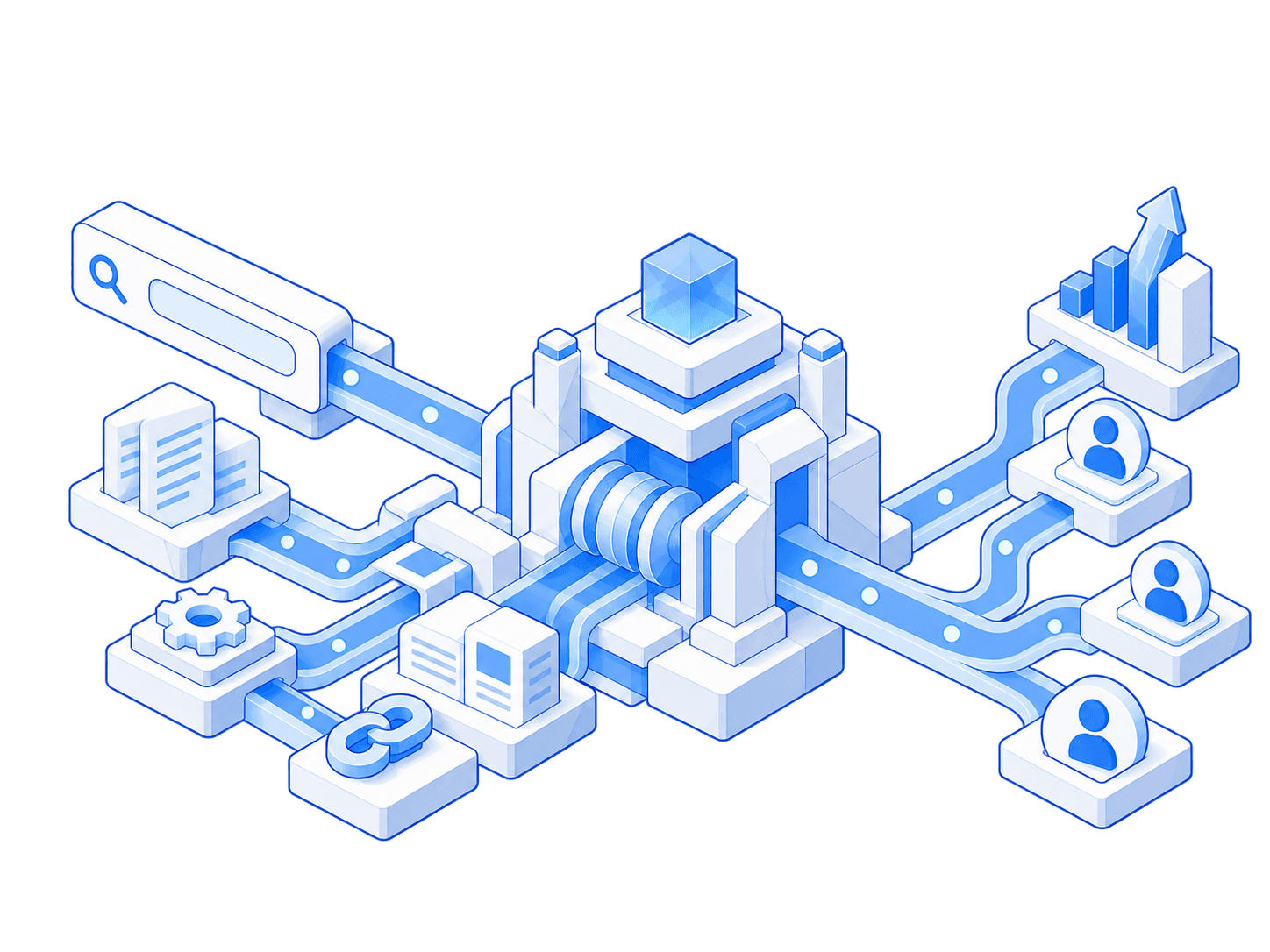
Search Engine Optimization

SEO that drives demand, not just rankings.

We help B2B companies grow qualified organic demand by improving technical foundations, search visibility, content coverage, authority, and the pages buyers rely on when deciding who to work with.

Fig. 01 — Search demand pathLive
BUYER SEARCHSEARCH RESULTS12345YOURSHIGH-INTENT PAGEQUALIFIED INBOUND

Ranking is useful only when it connects the right buyer to the right page.

The Problem

More traffic does not automatically mean more pipeline.

SEO often gets reduced to rankings, traffic, and publishing volume.

But B2B growth depends on whether the right people find you for the right searches, reach pages that answer what they need to know, and have a clear path toward becoming a customer.

A page ranking for the wrong intent can look successful in a dashboard while contributing very little to the business.

01Search demand

Are buyers actually searching for what you offer?

Volume around a topic is not the same as demand for the thing you sell. The first question is whether real commercial search demand exists in your category at all.

02Intent

Are you visible when buyers are comparing options?

Plenty of sites rank well for the searches buyers make first and disappear entirely from the ones they make last, when a vendor is actually being chosen.

03Conversion

Does organic traffic have somewhere useful to go?

Visibility only becomes pipeline if the page a buyer lands on answers what they came for and gives them an obvious next step.

Definition

Modern SEO is a system, not a publishing calendar.

Strong organic growth comes from aligning technical foundations, search demand, content architecture, authority, and conversion around how buyers actually research.

Fig. 02 — Organic growth system6 layers
01

Technical foundation

Help search engines crawl, understand, and index the right pages.

02

Search demand

Understand what your buyers are actually looking for.

03

Content architecture

Build the right pages around topics, problems, categories, comparisons, and buying intent.

04

Authority

Strengthen the signals that support relevance and credibility.

05

Conversion

Turn organic visibility into qualified inbound.

06

Measurement

Track what contributes to business outcomes and improve what is working.

Qualified organic demand
Diagnosis

Most SEO problems are not really ranking problems.

01

The site targets keywords without understanding buyer intent.

02

Important commercial and decision-stage pages do not exist.

03

Technical problems make strong content harder to discover or index.

04

Content is published without a clear architecture or internal-linking strategy.

05

Competitors have stronger authority around the topics that matter.

06

Organic traffic grows without producing meaningful conversions.

07

Teams measure rankings and sessions without understanding business impact.

The System

A system for building organic growth that compounds.

Fig. 03 — SEO growth loopContinuous
AUDIT01FOUNDATION02DEMAND03CONTENT04AUTHORITY05MEASURE06COMPOUNDING
01

Audit

Understand technical health, existing visibility, demand, competitors, content gaps, and where organic growth can create the most value.

02

Foundation

Fix the technical, structural, and architectural issues limiting search performance.

03

Demand

Map the queries, topics, categories, comparisons, and buying journeys worth competing for.

04

Content

Build and improve pages around commercial intent, buyer questions, and meaningful search opportunities.

05

Authority

Strengthen internal and external signals that improve credibility and ranking potential.

06

Measure

Track rankings, traffic, conversions, qualified inbound, and what is actually moving the business forward.

Capabilities

The parts of organic search that actually move performance.

01

SEO Research & Strategy

  • Search demand analysis
  • Keyword and query research
  • Competitive benchmarking
  • Search intent analysis
  • Opportunity prioritization
  • Buyer-journey mapping
02

Technical SEO

  • Crawl and indexation
  • Site architecture
  • Internal linking
  • Schema and structured data
  • Sitemaps and robots
  • Canonicalization
  • Redirects
  • Page performance
  • Technical hygiene
03

Content Architecture

  • Category and solution pages
  • Topic clusters
  • Pillar and supporting pages
  • Comparison content
  • Use-case pages
  • Decision-stage content
  • Information architecture
04

Content & On-Page SEO

  • Content briefs
  • Page creation
  • Existing-page optimization
  • Search-intent alignment
  • Title and metadata improvements
  • Internal-linking improvements
  • FAQ and supporting content
05

Authority

  • Relevant backlinks
  • Editorial mentions
  • Industry sources
  • Digital PR opportunities
  • Partner and ecosystem opportunities
  • Off-site credibility
06

Measurement & Attribution

  • Keyword rankings
  • Organic traffic
  • Landing-page performance
  • Search Console performance
  • Conversion tracking
  • Qualified inbound
  • Pipeline and revenue where measurable
Intent

The best SEO strategy follows the buyer, not the keyword list.

Different searches represent different stages of the buying journey.

A buyer learning about a problem needs something different from a buyer comparing vendors or checking whether your company is the right choice.

Fig. 04 — Search intent journey5 stages
Discover
“how to solve…”
Understand
“best way to…”
Compare
“X vs Y”
Validate
“X reviews”“is X worth it”
Buy
“X pricing”“book demo”

The goal is not to rank for everything. It is to be visible when the right buyer is making the right decision.

Convergence

SEO and AI search are becoming part of the same discovery system.

Strong technical structure, useful content, clear entities, authority, and third-party credibility can influence both traditional search visibility and how AI systems understand and recommend a brand.

That does not make SEO and AEO identical. It means the strongest search strategies increasingly account for both.

Fig. 05 — Modern searchShared signals
SEOCRAWLABILITYRANKINGSSEARCH DEMANDLINKSCONTENTAEOCITATIONSENTITY CLARITYTHIRD-PARTY SOURCESRECOMMENDATION VISIBILITYAI ANSWERSSHAREDUSEFUL CONTENTAUTHORITYTECHNICAL CLARITYBRAND TRUST
Proof

What measurable organic progress looks like.

Healthcare / Physician-Led Concierge Medicine

Starting point

Real clinical authority that search was not surfacing. The opening audit found 1,733 site issues, including 195 critical and 299 high priority, with weak service and location architecture, thin internal linking, and inconsistent business information.

What changed

We rebuilt the technical foundation, structured data and location architecture, then built content against real commercial patient questions — 32 new or improved articles, 32+ optimized location pages and a 50-entry glossary hub — and expanded off-site authority.

Result

Site Health rose from 76.9 to 84.4 and Technical Score from 83.4 to 90.4. Organic Search went from roughly a third of tracked inbound actions to more than half, and became a meaningful source of new patient demand.

Metric 01
22,99336,059

Google Search clicks (+56.8%)

Metric 02
1857

Organic form submissions (+216.7%)

Metric 03
40111

Organic waitlist signups (+177.5%)

Engagement

What the first 90 days looks like.

Days 1–30

Baseline + opportunity

  • Understand the business and buyer
  • Establish technical baseline
  • Review existing search visibility
  • Map commercial search demand
  • Identify content and competitive gaps
  • Build the initial roadmap
Days 31–60

Fix + build

  • Resolve priority technical issues
  • Improve existing high-value pages
  • Build missing commercial content
  • Strengthen internal linking
  • Begin authority work
  • Monitor early movement
Days 61–90

Expand + compound

  • Expand into additional opportunities
  • Strengthen pages gaining traction
  • Improve weaker query groups
  • Build authority around priority topics
  • Improve conversion pathways
  • Connect organic performance to inbound where possible

The program keeps following the same cycle: diagnose, prioritize, build, measure, and compound.

Fit

SEO works best when search demand already exists around the problem you solve.

Strong fit

  • B2B SaaS
  • Technology companies
  • Professional services
  • Financial services
  • High-consideration purchases
  • Categories with meaningful organic demand
  • Companies competing in complex buyer journeys

Probably not a fit

  • No established market demand
  • No meaningful website foundation
  • Looking only for cheap traffic
  • Wanting guaranteed rankings
  • Expecting SEO to work without content, authority, or technical investment
FAQs

Frequently asked questions

SEO improves how easily search engines can discover, understand, rank, and surface your website for searches relevant to your business and buyers.

Free Search Audit

Find the organic opportunities your competitors are already winning.

We will show you where search demand exists, where your site is underperforming, and where we would focus first.