Case Studies/PrimaryMD
PrimaryMD

PrimaryMD

Physician-Led Concierge Medicine · primary-md.com

Healthcare / Physician-Led Primary & Concierge Medicine

How PrimaryMD became a top AI recommended practice and turned search visibility into new patients in 90 days.

In 90 days, PrimaryMD moved from approximately #6 to #1.5 in average AI recommendation position, increased Google Search clicks by 56.8%, grew AI mentions more than 5X, and turned organic visibility into a meaningful source of inbound demand and new patients.

#1.5

Avg AI Position, up from #6

+216.7%

Organic Typeform Submissions

+177.5%

Organic Waitlist Signups

+56.8%

Google Search Clicks

The Challenge

Real clinical authority that AI engines weren't surfacing.

PrimaryMD already had something most healthcare brands spend years trying to build: real clinical authority. The practice combined physician led primary care, advanced diagnostics, longer appointments, continuity of care, and proactive health management with credible medical leadership.

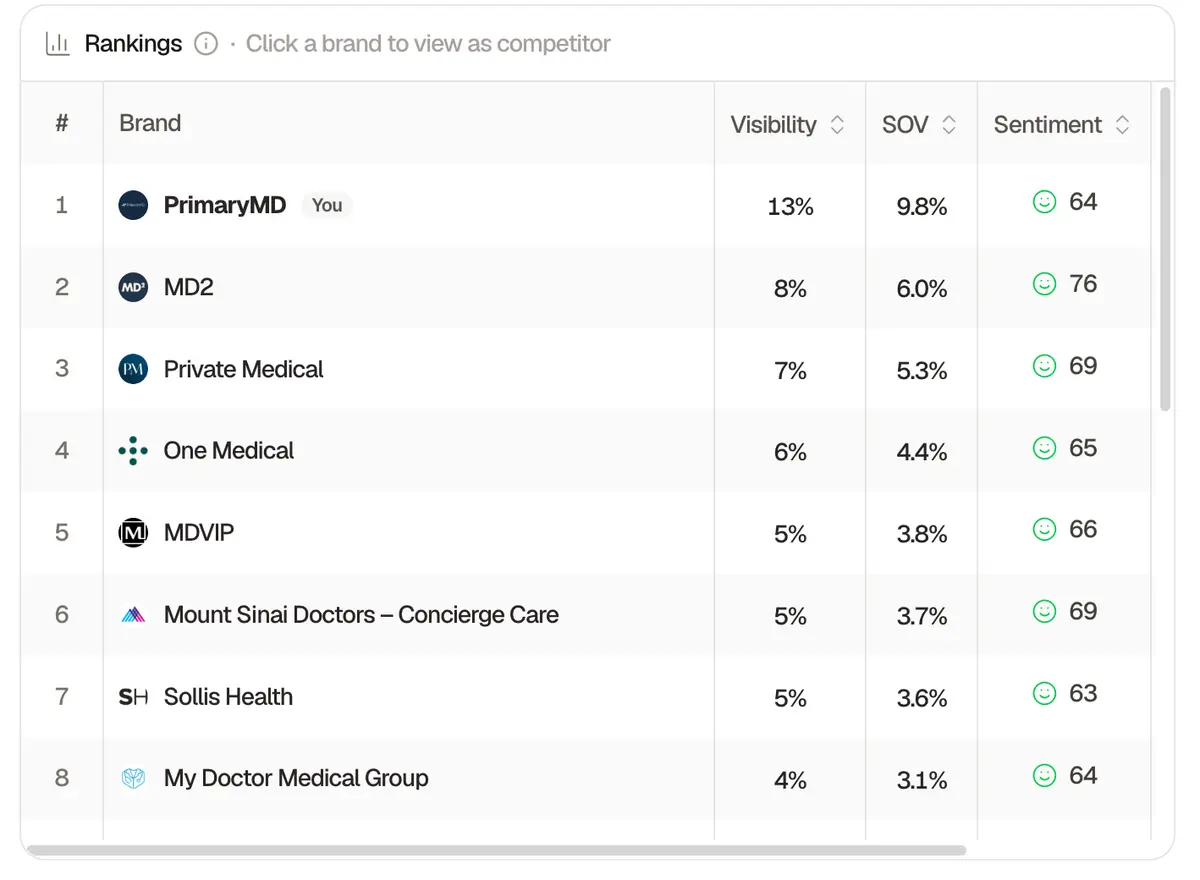
But that authority wasn't translating into search visibility, AI recommendations, or enough discoverability among prospective patients who didn't already know the PrimaryMD name. At the beginning of the engagement, PrimaryMD averaged approximately #6 when it appeared in tracked AI answers. Only 33% of its appearances were in the #1 position, while nearly half were buried at position #5 or lower. PrimaryMD held just 5.9% share of voice across its tracked competitive set, with 672 tracked AI mentions and 273 AI citations.

The problem was even more pronounced deeper in the patient decision journey. PrimaryMD had 0% purchase stage AI visibility, meaning the practice could occasionally appear while someone researched a health topic or model of care, but largely disappeared when prospective patients moved closer to choosing a provider.

There was also a significant technical foundation to address. Our initial audit identified 1,733 outstanding site issues, including 195 critical issues and 299 high priority issues. PrimaryMD was missing or underusing important signals around Service schema, LocalBusiness schema, physician entities, structured answers, internal linking, location architecture, and consistent business information.

PrimaryMD already had the physicians, clinical expertise, and care model. We needed to make that authority visible to Google, understandable to AI engines, and discoverable by the patients looking for it.

#6 avg AI position5.9% share of voice0% purchase stage visibility1,733 site issues
The Strategy

Make PrimaryMD easier to discover, understand, cite, recommend, and ultimately choose.

Rather than treating traditional SEO and AI search as separate channels, we worked on the underlying authority signals that influence both. The campaign focused on commercially relevant patient questions around concierge medicine, concierge medicine cost, private primary care, executive health, advanced diagnostics, DEXA scans and body composition, physician led proactive care, location specific concierge medicine, and membership and care model comparisons.

The goal was not simply to generate more impressions or publish more content. We wanted PrimaryMD to become one of the sources Google and AI engines relied on when prospective patients were researching their health, comparing models of care, evaluating providers, and deciding which practice to trust.

1

Build content around real patient questions

We substantially expanded PrimaryMD's content footprint: 32 new or substantially improved articles, more than 32 optimized location pages, at least 4 new service pages, a new glossary hub with 50 entries, and additional video content. But volume wasn't the strategy — each asset was built to strengthen PrimaryMD's authority around specific questions prospective patients were already asking, including “How much does concierge medicine cost?”, “Is concierge medicine worth it?”, and “What should I expect from a concierge doctor in New York?”

The strongest early results came from exactly these high intent topics. PrimaryMD's concierge medicine cost content became one of the most frequently used commercial assets in tracked AI sources, and Google began surfacing them, AI engines began citing them, and prospective patients began finding PrimaryMD through them.

32

New or improved articles

32+

Optimized location pages

50

Glossary hub entries

2

Connect PrimaryMD's physicians to the brand

One of PrimaryMD's strongest competitive advantages was already there: its physicians. A significant part of the campaign focused on making it easier for Google and AI systems to connect Dr. Sarge Takhar's existing medical and academic authority with PrimaryMD, through identity connections, physician schema, improved bio architecture, author attribution, internal linking, and stronger medical expertise signals across the site's content. Relevant profiles such as Google Scholar, Doximity, and LinkedIn were connected back to the physician entity.

PrimaryMD is not simply another longevity brand. It is physician led primary care built around clinical judgment, continuity, diagnostics, and proactive medicine — and that distinction became increasingly visible in how AI systems described the brand.

3

Strengthen the technical foundation

PrimaryMD started the engagement with 1,733 identified site issues. We addressed technical SEO, structured data, internal linking, entity consistency, location architecture, answer structure, and AEO fundamentals across the site, giving search engines and AI systems a cleaner, more consistent understanding of PrimaryMD's physicians, services, locations, expertise, and content.

76.984.4

Site Health Score

83.490.4

Technical Score

70.478.4

AEO Score

4

Build authority beyond primary-md.com

AI engines don't determine authority based only on what a company says about itself — they look for corroboration across the web. We expanded PrimaryMD's external footprint across relevant medical, local, and business platforms, including Yelp, Hotfrog, BirdEye, Doctor.com, MediFind, BBB, Castle Connolly, Apple Business Connect, and Bing Places. Combined with the content and technical work, this created a broader evidence layer AI systems could use when deciding whether PrimaryMD deserved to be cited or recommended.

The Results

Organic Search became a meaningful source of new patient demand.

The most commercially important result wasn't simply more traffic. It was what prospective patients did after finding PrimaryMD.

1857

Organic Typeform Submissions (+216.7%)

40111

Organic Waitlist Signups (+177.5%)

#6#1.5

Average AI Recommendation Position

22,99336,059

Google Search Clicks (+56.8%)

Typeform submissions: 38.3% → 56.4% from Organic Search Organic Search's share of all Typeform submissions grew from just over a third to more than half.

Waitlist signups: 31.8% → 53.6% from Organic Search Organic Search's contribution to total waitlist signups followed the same pattern.

Organic Search drove more than half of both tracked inbound actions For PrimaryMD, these weren't simply analytics events — the increased inbound activity translated into new clients for the practice.

The search strategy wasn't only creating visibility. It was creating patient demand.

AI Recommendation Position

PrimaryMD moved from approximately #6 to #1.5 in AI recommendations.

At the beginning of the engagement, PrimaryMD averaged approximately #6 when it appeared in tracked AI answers. After 90 days, its average position had improved to approximately #1.5. The distribution changed even more dramatically: at baseline, only 33% of appearances were in position #1, while 47% were position #5 or lower. By the end of the campaign, 73% of appearances were #1, 26% were #2, 99% of all appearances were in the first two positions, and only 1% remained at #5 or lower.

PrimaryMD didn't simply start appearing more often. It moved to the front of the recommendation.

Position #1
33%73%
Top Two Positions
53%99%
Position #5 or Lower
47%1%
Mentions & Citations

AI mentions grew more than 5X. Citations more than tripled.

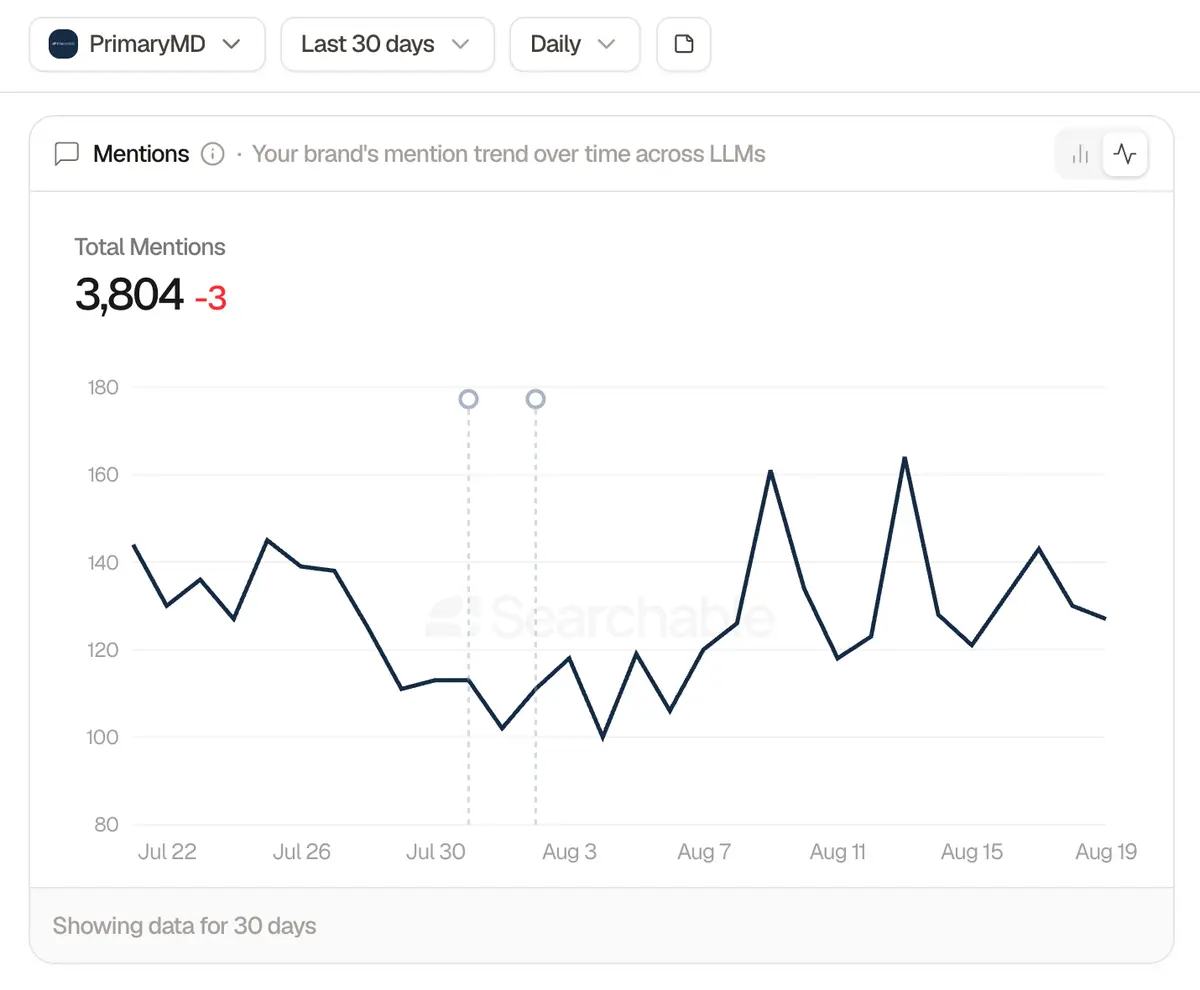
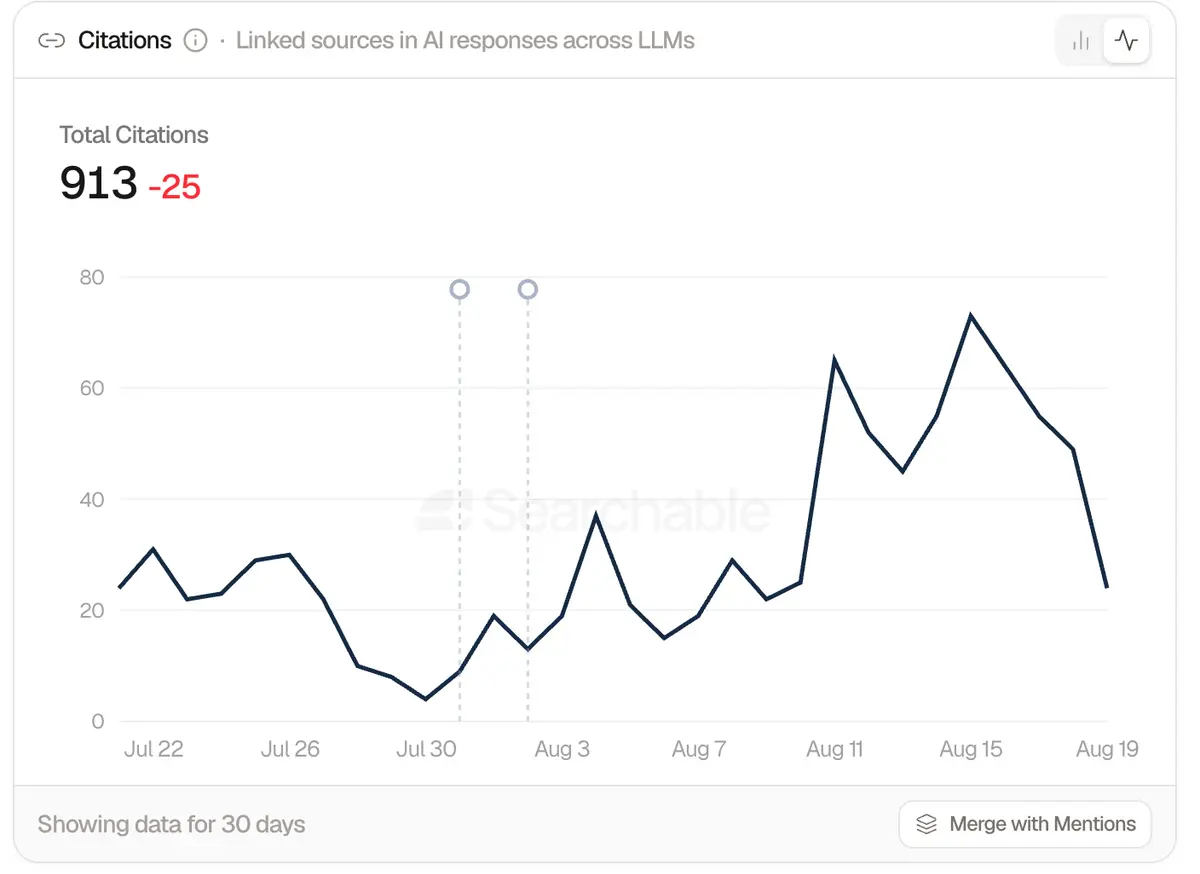
Mentions tell us an AI engine knows a brand exists. Citations tell us it considers the brand's content useful enough to support an answer. PrimaryMD began the campaign with 672 tracked AI mentions and 273 AI citations. By the end of the engagement, mentions had increased to 3,804 — approximately 5.7X the original volume — and citations had grown to 913, approximately 234% growth.

Even more importantly, AI systems were no longer relying on only a handful of PrimaryMD pages. By the end of the campaign, 162 separate PrimaryMD URLs were being cited across AI answers. The content library had become a genuine source layer for AI engines.

6723,804

AI Mentions (5.7x)

273913

AI Citations (+234%)

5.9%9.8%

Share of Voice (+66%)

162

Separate URLs Cited by AI

Decision Journey

Purchase stage AI visibility went from 0% to 26.9%.

One of the most commercially meaningful improvements happened at the bottom of the funnel. Top of funnel visibility declined and remains an opportunity for future growth, but PrimaryMD became dramatically stronger where patient intent was highest. Consideration visibility increased substantially, and purchase visibility went from nonexistent to 26.9%.

This change matters even more when viewed alongside the growth in Typeform submissions and waitlist signups. PrimaryMD became more visible when prospective patients were closer to choosing a provider, while Organic Search simultaneously became a much larger contributor to inbound patient activity.

PrimaryMD was increasingly showing up when the decision mattered.

TOFU · Learn
10.6%4.8%
MOFU · Consider
12.8%20.3%
BOFU · Purchase
0%26.9%
Search & Patient Demand

The AI gains happened alongside significant traditional search growth.

Google Search clicks increased from 22,993 to 36,059 — 13,066 additional clicks and 56.8% growth. Search impressions increased from approximately 2.29 million to 2.83 million, an increase of 23.7%, and CTR improved from 1.00% to 1.27%. PrimaryMD wasn't simply appearing for more searches — searchers became more likely to click when it appeared.

GA4 showed nearly identical growth from the website side. Organic Search sessions increased from 30,027 to 47,041 (56.7% growth), organic users increased from 23,384 to 35,625 (52.4%), organic engaged sessions increased by 47.7%, and organic views increased by 49.8%. The consistency between Google Search Console and GA4 showed that the growth wasn't isolated to a single measurement system.

One of the strongest signals was where that growth came from. Non branded queries generated 21,126 clicks and more than 1.08 million impressions — more than 96% of reported query clicks. That means the growth wasn't dependent on prospective patients already knowing PrimaryMD by name.

People were discovering PrimaryMD while searching for the problems, services, and models of care the practice was built around.

Geographic visibility was another major focus. Across PrimaryMD's location pages, Google Search clicks increased from 767 to 1,704 (122.2% growth) and organic sessions increased from 797 to 1,621 (103.4% growth). The main New York page approximately doubled its organic traffic, while additional pages such as Scarsdale and Cobble Hill began creating new local search entry points.

30,02747,041

Organic Search Sessions (+56.7%)

7671,704

Location Page Search Clicks (+122.2%)

Brand Perception

AI perception shifted toward the brand PrimaryMD wanted to build.

Overall sentiment increased from 56.3 to 61.8. ChatGPT perception increased from 57 to 65, Google AI Overviews increased from 60 to 66, and Perplexity increased from 58 to 60. More importantly, AI systems increasingly associated PrimaryMD with strong clinical leadership, physician first care, physician led primary care, credible physician credentials, thoughtful interpretation of health data, continuity of care, long appointments, proactive medicine, advanced diagnostics, dedicated care teams, and wearable integration.

The brand narrative moved away from generic longevity positioning and toward the areas PrimaryMD actually wanted to own: physician judgment, continuity, serious medicine, and proactive care.

5765

ChatGPT Perception

6066

Google AI Overviews

5860

Perplexity

The Outcome

From clinical authority search engines struggled to surface, to a search presence that drives patients.

PrimaryMD began the engagement with substantial real world clinical authority, but Google and AI engines weren't consistently translating that authority into discovery, recommendations, or patient demand. Ninety days later, the position looked materially different.

Increased organic Typeform submissions by 216.7%, from 18 to 57
Increased organic waitlist signups by 177.5%, from 40 to 111
Turned the increase in inbound activity into new clients
Moved from approximately #6 to #1.5 average AI recommendation position
Reached the top two positions in 99% of tracked AI appearances
Increased AI mentions from 672 to 3,804
Increased AI citations from 273 to 913
Increased share of voice by approximately 66%
Moved purchase stage AI visibility from 0% to 26.9%
Increased Google Search clicks by 56.8%
Increased Organic Search sessions by 56.7%
More than doubled search traffic to its location pages

The biggest result wasn't simply that PrimaryMD became easier to find. It was that visibility moved closer to the patient decision. More people discovered PrimaryMD through non branded search. More AI engines cited its expertise. PrimaryMD moved toward the top of AI recommendations. More prospective patients entered its Typeform and waitlist funnels. And that increased inbound demand translated into new clients.

PrimaryMD went from having clinical authority that search engines struggled to surface to building a search presence that could actively contribute to patient acquisition.

Your practice deserves to be found.

If your clinical authority is strong but patients aren't finding you in ChatGPT, Perplexity, or Google AI Overviews, the gap may be smaller than it looks. We can audit your current AI visibility, identify the highest-leverage opportunities, and show you what a 30/60/90 day AEO plan looks like for your practice.

Book a strategy call

No obligation, no generic deck.